The Domino Effect: Why Digital ROI Is Never a Straight Line
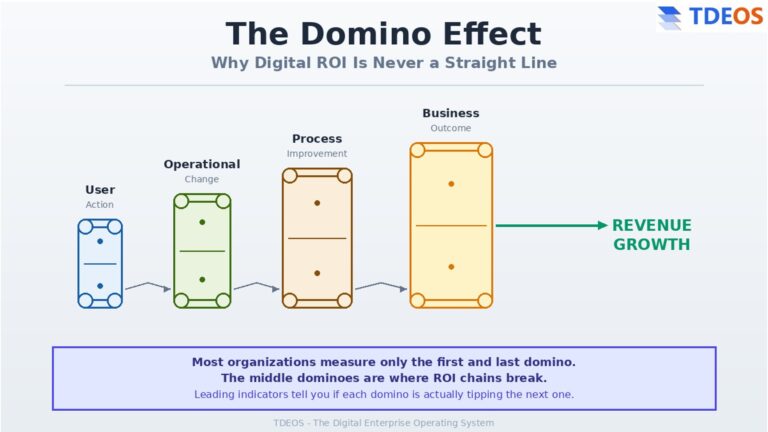
A recent conversation with a credit union CEO reinforced a pattern I continue to see across mid-market organizations: most companies don’t struggle with buying technology. They struggle with connecting activity to outcomes. Technology investments are measured at the extremes. On one end: adoption metrics, login rates, feature usage. On the other end: business outcomes like revenue growth and cost reduction. The problem is the gap between them. This is where the domino effect comes in. Technology ROI isn’t a straight line from implementation to revenue. It’s a chain reaction. Small dominoes represent daily user actions. Medium dominoes represent operational improvements. Large dominoes represent process effectiveness. The largest dominoes are business outcomes. Most organizations only measure the first domino and the last domino. They miss the middle—where ROI chains actually break.