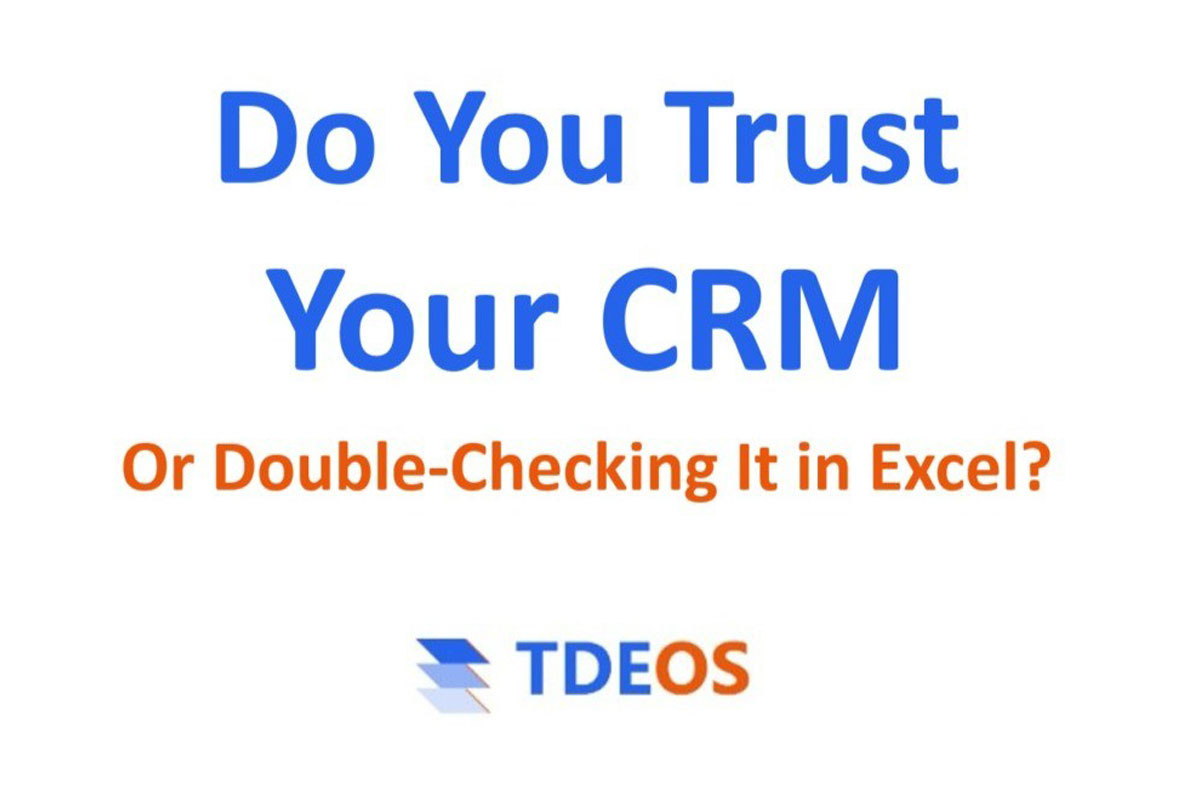
A CRO at a mid-market SaaS company had started asking his sales leaders for pipeline reports in Excel instead of pulling them from CRM.
Why? Because he noticed discrepancies in CRM dashboards.
- Deals marked as 90% probable that never closed.
- Forecast accuracy declining quarter over quarter.
- Pipeline reports that did not match what his VPs were saying in leadership meetings.
He started double-checking the numbers. Running his own calculations. Asking for data in formats he could verify.
Eventually, he stopped opening the CRM dashboards altogether.
When he needed to present pipeline to the board, he asked his VP of Sales for the real numbers. Not the CRM numbers. The real ones.
That is the moment a CRM stops being a system of record and becomes performance theater.
The Illusion of Adoption
On paper, the CRM had 94% adoption. But most reps had built their own system outside of CRM. Some in Excel. Some in Notion. Some in Google Sheets. Coworkers frequently shared links to those files in Slack and email.
I sat through a typical sales rep working through a customer call. Right before the customer meeting, sales rep opened three Excel files. Then at the end of the call, she updated Salesforce.
- CustomerNotes_Final_v3.xlsx held the account details she referenced during the call.
- FollowUp_Tracker.xlsx managed her next actions.
- MyPipeline_Updated.xlsx contained her actual forecast.
- Lastly, she updated Salesforce for leadership visibility.
CRM was technically in use. Logged in. She had adopted the CRM. But had she really?
When she needed information to close a deal, she went to her spreadsheets. Every time.
The CRM showed 94% adoption. The reality was closer to 30% genuine reliance.
But the bigger problem was not what the sales team was doing. It was what the CRO had already stopped doing: trusting the CRM.
This mirrors the pattern I described in The Shadow CRM—when teams build their own tracking tools because the official system doesn’t serve their needs.
The Trust Gap Compounds
Once leadership stops trusting the data, the system cannot recover without deliberate intervention.
Training will not fix it. Reiterating the importance of data quality will not fix it. Sending reminder emails about logging activity will not fix it.
The trust gap compounds.
Leadership questions the data. Teams sense that leadership does not rely on the system. Data quality declines further because no one believes it matters. Leadership trusts it even less.
The cycle reinforces itself.
Within 12 months, the CRM exists primarily to satisfy compliance requirements. Leadership makes decisions based on information gathered outside the system. Teams log activity because it is required, not because it informs their work.
The expensive platform becomes a data entry burden that no one genuinely relies on.
Why This Happens Predictably
Most CRM projects focus on implementation.
Configure the fields. Build the workflows. Integrate the tools. Train the users. Go live. Celebrate the launch.
Implementation is a project with a finish line.
Operationalization is ongoing organizational work. It requires governance. Accountability. Standards. Regular health checks. Executive ownership.
Most companies stop after implementation. They assume the system will sustain itself.
It will not.
Without active governance, entropy wins every time.
Custom fields proliferate because different departments request them and no one says no. Data quality declines because there are no consequences for incomplete records. Workarounds emerge because the system does not match how work actually happens. Shadow systems formalize because they are more useful than the official tool.
The CRM becomes what I call an audit log rather than a decision engine. It tracks what happened, but it does not help anyone decide what to do next.
The Predictable Decay Timeline
The pattern is remarkably consistent across companies.
Months 1-3: High engagement. Teams are compliant. Leadership is optimistic. The dashboards look clean. Adoption metrics are strong.
Months 4-6: Workarounds begin to emerge. A few spreadsheets appear. Nobody mentions them in meetings. Leadership assumes the early momentum will continue.
Months 7-12: Shadow systems formalize. Top performers have built their own tracking tools. Data quality erodes quietly. Forecast accuracy starts declining. Leadership begins noticing discrepancies but assumes it is a training issue.
Month 13 onward: The CRM has become compliance infrastructure. Leadership no longer trusts it for decision-making. Teams maintain it because it is required, not because it is useful.
Most leadership teams notice the problem 18 months after go-live. By then, credibility has already been lost.
Restoring it requires more than a training refresh or a data quality initiative. It requires rethinking whether the system is designed to serve the people doing the work or to give management visibility into whether work is being done.
Those are not the same thing.
The Governance Vacuum
In every company where I have seen this pattern, there is a common root cause.
Nobody actually owns CRM health at the executive level.
IT built the system. Sales uses it. RevOps monitors it. The CRM administrator maintains it.
But who is accountable for whether it actually works? For whether leadership can trust the data? For whether teams find it useful enough to rely on?
In most organizations, that question does not have a clear answer.
Ownership has been delegated downward. The CRM admin is responsible for keeping the system running, but they are not empowered to enforce data standards across departments. The VP of Sales wants accurate pipeline visibility, but they do not own the Customer Success team’s adoption. IT manages the technical infrastructure, but they have no visibility into whether the business is getting value.
Without clear executive ownership, the system drifts.
No one makes the hard calls about simplifying custom fields. No one enforces consequences for poor data quality. No one regularly asks whether the CRM is serving decisions or just tracking activity.
The governance vacuum allows decay to proceed unchecked.
If your CRM has reached this state, our CRM governance consulting can help restore credibility through executive-level frameworks and accountability structures.
When the Moment Arrives
I asked the SaaS company CRO a question that every executive should be asking:
“If your CRM disappeared tomorrow, what would your team actually miss?”
Not what they use because they have to. What would they genuinely want back?
He sat with that question for a while.
Eventually he said: “Probably not much. They would miss the contact database. Maybe opportunity tracking. But everything else? They have already built better versions.”
That is the moment the conversation shifts.
Not from whether to retrain the team. Not from whether to hire another admin or buy more licenses.
From whether the CRM is designed to serve the people doing the work, or designed to give management visibility into whether the work is being done.
If your CRM primarily exists to monitor activity rather than enable performance, shadow systems are inevitable. And so is the erosion of executive trust.
The Real Question
The issue is not whether your team is logging into the CRM.
The issue is whether you trust the data enough to make decisions with it.
When was the last time you made a material business decision based solely on what your CRM told you? Without double-checking the numbers in a spreadsheet? Without asking for the real forecast from your VP?
If the answer is “I cannot remember,” you do not have an adoption problem.
You have a trust problem.
And trust, once lost, does not return through training or enforcement.
It returns through governance, accountability, and a willingness to ask whether the system you built actually serves the decisions you need to make.
Frequently Asked Questions
How do you know if your leadership trusts your CRM data?
Ask yourself: When was the last time you made a material business decision based solely on what your CRM told you, without double-checking in a spreadsheet? If the answer is “I can’t remember,” you have a trust problem, not an adoption problem.
What causes CRM trust erosion?
Most companies stop after implementation and assume the system will sustain itself. Without active governance, accountability structures, and regular health checks, data quality declines, workarounds emerge, and leadership gradually stops relying on the system for decision-making.
Can CRM trust be restored once it’s lost?
Yes, but not through training or enforcement alone. It requires executive-level governance ownership, clear accountability for data quality, and a willingness to redesign workflows to match how work actually happens—not how you wish it happened.
Who should own CRM governance in a mid-market company?
CRM governance needs executive-level ownership—typically a COO, VP of Operations, or Revenue Operations leader who has authority across departments. The CRM admin maintains the system, but governance decisions (data standards, workflow changes, adoption enforcement) need executive backing to succeed.
How long does it take for CRM trust to erode after go-live?
The pattern is remarkably consistent: Months 1-3 show high engagement, months 4-6 see workarounds emerge, months 7-12 see shadow systems formalize, and by month 13+ the CRM becomes compliance infrastructure rather than a decision engine. Most leadership teams notice the problem 18 months after go-live—after credibility has already been lost.
AUTHOR BIO
About the Author
Raman Arora is the founder of TDEOS (The Digital Enterprise Operating System), a CRM and digital transformation consultancy serving mid-market organizations. With 22+ years of Fortune 500 operations experience at GE, Paycor, Dell, Farmers and more. Raman specializes in helping financial services, nonprofits, healthcare, and professional services firms close the gap between technology investment and measurable business outcomes. He is a monday.com certified partner and Make.com certified consultant.
Is your CRM losing leadership trust?
We help mid-market organizations restore CRM credibility through governance frameworks, data quality audits, and workflow redesign that matches how your teams actually work.
Schedule a CRM Health Assessment to diagnose where trust is breaking down.