
Welcome to this edition of The Digital Enterprise, where we explore how technology leaders can turn digital ambition into measurable outcomes.
In this edition, how Mercedes-Benz discovered that car sales weren’t about the car – and what this teaches us about measuring what actually matters in enterprise evolution.
The Dealership Discovery That Changed Everything
In the early 2000s, Mercedes-Benz faced an unexpected challenge. Despite producing world-class luxury vehicles, they were struggling to maintain their competitive edge. The automotive market was becoming increasingly crowded, and competitors were closing the gap on traditional differentiators like engineering excellence and brand prestige.
Most automotive executives would have doubled down on product features – more horsepower, better technology, enhanced design. Mercedes-Benz took a different approach. They looked at their data differently.
It Wasn’t About the Car
Through careful analysis of customer satisfaction scores, Mercedes-Benz made a counterintuitive discovery: dealership satisfaction scores were a stronger predictor of future car sales than product satisfaction scores.
Think about that for a moment. The quality of the service experience at the dealership – not the quality of the car itself – was the primary driver of purchase decisions and brand loyalty.
This insight led to a fundamental shift in strategy. Instead of focusing solely on automotive engineering, Mercedes-Benz invested heavily in transforming the dealership experience:
- Redesigned showrooms with hospitality-focused layouts
- Upgraded service facilities with customer comfort in mind
- Implemented comprehensive service training programs
- Created seamless integration between online and in-person experiences
- Established new service standards that prioritized customer convenience
The results were dramatic. By focusing on the “right metric” – dealership experience rather than just product features – Mercedes-Benz differentiated itself in ways that directly translated to increased sales and customer loyalty.
The Competitive Response
Of course, success stories don’t remain secret for long. Within a few years, competitors began implementing similar dealership experience improvements. BMW, Audi, and other luxury brands invested in their own service experience transformations.
But Mercedes-Benz had gained something invaluable: they had learned how to identify and optimize the metrics that actually drive business outcomes, not just the metrics that seem obvious.
The Enterprise Technology Parallel
This story perfectly illustrates the challenge facing organizations with their technology initiatives today. Most companies are measuring the wrong things – and consequently, burning out their IT teams while optimizing for the wrong outcomes.
Consider these common scenarios that lead to IT exhaustion:
What Most Organizations Measure (And Demand More Of):
- System uptime and performance
- Feature delivery timelines
- User adoption rates
- AI project implementations
- Cloud migration milestones
What Actually Drives Business Value:
- Customer effort reduction
- Revenue per customer interaction
- Time from insight to action
- Business process cycle time improvement
- Employee productivity enhancement
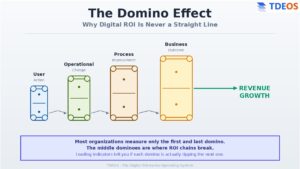
The gap between these two sets of metrics creates what we call the Digital Value Gap – the disconnect between successful technology implementation and meaningful business impact. And it’s burning out your best people.
The Hidden Cost: IT Team Burnout
Here’s what happens when organizations focus on the wrong metrics:
IT teams get overwhelmed with demands to:
- Implement more AI pilots (without clear business cases)
- Migrate faster to the cloud (without process optimization)
- Deploy more features (without measuring business impact)
- Maintain higher system uptime (without understanding user needs)
- Support more technology initiatives (without strategic prioritization)
The result? Even the strongest IT leaders burn out when the system forces them to say yes to everything. Teams become reactive, constantly firefighting, unable to focus on initiatives that actually move the business forward.
Our client said it best: ‘I feel like I’m juggling flaming swords while being asked to build a spaceship.’
Finding Your “Dealership Experience” Metric
Just as Mercedes-Benz discovered that dealership satisfaction predicted car sales, every organization has hidden metrics that better predict technology success than the obvious ones.
Here’s how to identify them:
1. Look Beyond the Technology
Ask yourself: What business outcome are we actually trying to achieve? Then work backward to identify the leading indicators of that outcome.
Example: If your AI initiative aims to improve customer service, don’t just measure model accuracy. Measure customer effort scores, first-call resolution rates, and agent satisfaction with AI recommendations.
2. Find the Surprising Correlations
Analyze your data to identify unexpected relationships between metrics.
Example: A financial services company discovered that internal employee satisfaction with new tools was a stronger predictor of customer satisfaction than external portal features. Their overwhelmed IT team was building the wrong things.
3. Focus on Proxy Metrics
Identify metrics that indicate future success rather than just current performance.
Example: Instead of measuring completed AI training sessions, measure the rate at which employees actually use AI insights in their daily decisions.
The Relief Factor: Right Metrics Reduce IT Pressure
When organizations focus on the right metrics, something interesting happens: IT teams become more strategic and less stressed.
Instead of juggling 20 AI projects with unclear value, teams can focus on 3-5 initiatives with clear business impact. Instead of constant feature requests, they get clear priorities based on business outcomes.
The Mercedes-Benz lesson applies here too: focusing on the right metrics doesn’t just improve results – it makes the work more sustainable.
The TDEOS Approach to Value Metrics
The Digital Enterprise Operating System (TDEOS™) framework addresses this challenge through our Value Measurement System, which helps organizations focus on metrics that actually predict business success while reducing IT team burnout:
- Leading Indicators: Metrics that predict future value realization
- Business Impact Focus: Direct connection to revenue, costs, and customer outcomes
- Strategic Prioritization: Clear criteria for saying no to low-value initiatives
- Value Optimization: Mechanisms to continuously improve based on what’s working
Your Action Plan
This week, challenge your team to identify your organization’s “dealership experience” metric while giving your IT teams some breathing room:
- Audit Your Current Demands: List all the technology initiatives and AI projects currently in flight
- Question the Obvious: For each initiative, ask “Does this predict business success or just measure activity?”
- Explore Correlations: Look for unexpected relationships in your data
- Prioritize Ruthlessly: Pick 1-2 leading indicators that might better predict your desired business outcomes
- Say No Strategically: Use data to prove which initiatives actually correlate with business success – and pause the rest
The Bottom Line
Mercedes-Benz’s dealership insight reminds us that success often comes from optimizing metrics that aren’t immediately obvious. In enterprise technology, the organizations that succeed – and avoid burning out their teams – are those that move beyond measuring implementation to measuring business transformation.
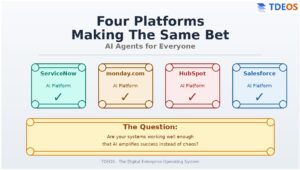
The question isn’t whether your systems are working or how many AI projects you’re running – it’s whether your technology initiatives are driving the business outcomes that matter.
What’s your “dealership experience” metric? The answer might just save your IT team’s sanity while transforming your business.
Ready to identify the metrics that actually drive your technology success while reducing team burnout?
Take our complimentary Digital Enterprise Maturity Assessment to discover which capabilities truly predict business value in your organization.
The Digital Enterprise Newsletter is published weekly, delivering insights on enterprise evolution, business strategy, and value realization. Subscribe for strategic perspectives that help you navigate the complexity of technology-driven change.
TDEOS™ – The Digital Enterprise Operating System Bridging the gap between technology implementation and business impact www.tdeos.com