Why CRM Systems Fail and How to Fix Them

CRM problems don’t show up at go-live. They show up months later when leadership stops trusting the data, teams build shadow systems, and your platform becomes compliance infrastructure instead of a decision engine.

These insights are based on 22+ years of Fortune 500 operations experience (GE Aviation, Dell, Chase, Farmers) and direct work with mid-market financial services, nonprofits, healthcare, and professional services firms navigating CRM implementation, AI governance, and digital transformation challenges.

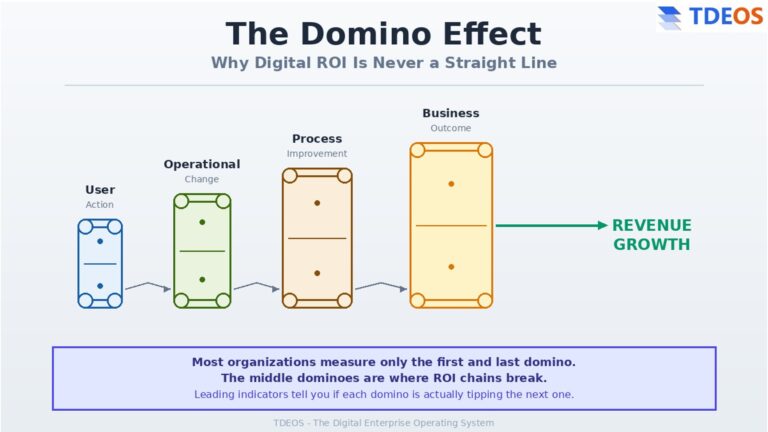
The Domino Effect: Why Digital ROI Is Never a Straight Line

A recent conversation with a credit union CEO reinforced a pattern I continue to see across mid-market organizations: most companies don’t struggle with buying technology. They struggle with connecting activity to outcomes. Technology investments are measured at the extremes. On one end: adoption metrics, login rates, feature usage. On the other end: business outcomes like revenue growth and cost reduction. The problem is the gap between them. This is where the domino effect comes in. Technology ROI isn’t a straight line from implementation to revenue. It’s a chain reaction. Small dominoes represent daily user actions. Medium dominoes represent operational improvements. Large dominoes represent process effectiveness. The largest dominoes are business outcomes. Most organizations only measure the first domino and the last domino. They miss the middle—where ROI chains actually break.
Read More »

Four Platforms Made the Same AI Bet: Why Mid-Market Companies Should Wait

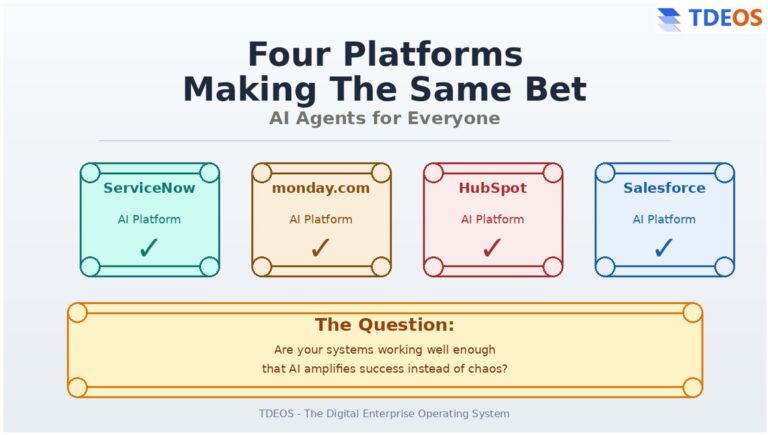
Four enterprise platforms made nearly identical bets in one week. ServiceNow positioned itself as “the AI platform for business transformation.” monday.com rebranded as an “AI Work Platform.” HubSpot called itself “the agentic customer platform.” Salesforce continued pushing Agentforce autonomous agents.

All promising the same thing: AI agents that plan, coordinate, and execute work without human intervention.

But here’s what nobody’s saying: if your systems are broken, AI will make them worse.

AI agents require clean data, defined processes, and clear governance—exactly what system drift destroys. If your sales team tracks real pipeline in Excel because they don’t trust your CRM, adding AI agents won’t fix that. The AI learns from bad data and makes confidently wrong predictions.

Mid-market companies need to fix their foundations first. Then deploy AI from a position of strength, not desperation.

Read More »

AI CRM Limitations: Pattern Recognition vs Understanding

A CEO complained their CRM’s AI kept flagging leads from industries they’d stopped targeting six months ago. The vendor said the AI was working correctly. They were both right. The AI was doing exactly what it was trained to do—match patterns from historical data. The business strategy changed. The AI’s training data didn’t.

Read More »
The-Year-After-Go-Live--Why-CRM-Success-Turns-Into-CRM-Struggle

The Year After Go-Live: Why CRM Success Turns Into CRM Struggle

A CIO asked me to audit their CRM six months after go-live. On paper, everything looked fine. Salesforce was live, users were trained, adoption was at 87%. But when I asked to see their actual workflows, the real story emerged. The system they built didn’t match how the team actually worked, and nobody had the authority to change it.

Read More »
When-Leadership-Stops-Trusting-the-CRM

When Leadership Stops Trusting the CRM

A CRO stopped opening CRM dashboards and started asking for pipeline reports in Excel instead. His forecast accuracy was declining, deals marked 90% probable weren’t closing, and the numbers didn’t match what his VPs said in meetings. That’s the moment a CRM stops being a system of record and becomes performance theater.

Read More »
The Shadow CRM

The Shadow CRM

Sales reps reference spreadsheets during customer calls. Leadership asks for “the real numbers” instead of pulling CRM reports. Top performers have built their own tracking systems that nobody talks about in meetings. That’s a shadow CRM—and it’s a symptom, not the problem.

Read More »