Hi there,
In previous editions, I shared my journey creating the TDEOS framework and introduced you to the Digital Value Gap—that frustrating disconnect between technology implementation and business value that plagues 70% of digital initiatives.
I’ll never forget that CEO who demanded I “Show him the iceberg”—a vivid reminder that going live with a digital tool isn’t success if users don’t actually use it to drive business outcomes.
Today, we’re diving into the first pillar of TDEOS: Enterprise Digital Strategy.
The Problem with Traditional Digital Strategy
Most digital strategies I encounter suffer from the same critical flaws:
- Too Generic: Broad statements like “enhance customer experience” or “improve operational efficiency” that don’t translate to actionable plans
- Technology-Centric: Focused on implementing specific tools rather than solving business problems
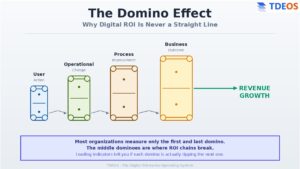
- Disconnected from Value: Unable to draw a straight line from strategic initiatives to tangible business outcomes
- Static Documents: Created once, then shelved away while the business and technology landscape continues evolving
This explains why 72% of organizations report their digital strategies don’t deliver expected outcomes
A digital strategy document that checks the “strategy” box but fails to guide meaningful transformation is worse than having no strategy at all—it creates the illusion of direction.
Enterprise Digital Strategy: The TDEOS Approach
The first pillar of TDEOS reimagines digital strategy through four integrated components:
1. Digital Vision Creation
Rather than generic aspirations, effective digital visions are:
- Tangible: Describing specific future capabilities, not vague end-states
- Value-Defined: Explicitly stating what success looks like in business terms
- Time-Bound: Setting clear horizons for transformation (18-month, 3-year, 5-year)
I recently worked with a mid-market manufacturing client whose digital vision evolved from “becoming a digital leader” to: “By 2026, we will reduce order-to-delivery time from 45 days to 5 days through predictive operations, automated quality management, and real-time supply chain visibility.”
The difference? The second version drives action and enables measurement.
2. Domain-Based Strategy
Perhaps the most distinctive aspect of TDEOS is its domain-based approach. Instead of organizing strategies around technologies or functions, we focus on business domains—interconnected capabilities that deliver value together.
For example, rather than a “cloud strategy” or “data strategy,” we develop specific strategies for domains like:
- Order Management Domain: Connecting sales, fulfillment, and customer service
- Product Development Domain: Linking R&D, engineering, and market feedback
- Employee Experience Domain: Integrating HR, workplace technology, and performance management
This approach breaks down traditional silos, maintains end-to-end focus on value streams, and creates clear ownership of outcomes.
3. Value Opportunity Prioritization
Not all digital initiatives deliver equal value, yet most organizations struggle to prioritize effectively. TDEOS employs a systematic prioritization framework evaluating:
- Business Impact: Revenue, cost, experience, and operational metrics
- Implementation Feasibility: Technical complexity, organizational readiness, resource requirements
- Strategic Alignment: Connection to business strategy, competitive positioning, market trends
- Risk Profile: Implementation risk, business disruption, regulatory considerations
This evaluation creates a balanced portfolio of initiatives:
- Quick wins (3-6 months)
- Strategic capabilities (6-18 months)
- Transformative innovations (18+ months)
4. Digital Investment Planning
The final component translates strategies into actionable investment plans with:
- Business Case Development: Clear ROI projections with specific value drivers
- Resource Planning: Technology, talent, and implementation requirements
- Execution Approach: Implementation methodology and governance
- Value Realization Planning: Specific metrics, measurement approach, and timeline
This component ensures that every dollar invested in digital initiatives has a clear path to return.
AI’s Role in Enterprise Digital Strategy
AI is transforming the very nature of digital strategy development. Beyond being just another technology to implement, AI now serves as both a strategic catalyst and enabler.
AI as a Strategic Planning Tool
Organizations at the forefront of digital transformation are leveraging AI to:
- Identify Hidden Value Opportunities: Advanced analytics and AI can uncover patterns in customer behavior, operational data, and market trends that human analysis might miss. One manufacturing client discovered a $12M efficiency opportunity by using AI to analyze production data that had been collected but never properly examined.
- Test Strategic Hypotheses: Rather than relying solely on intuition or limited data sampling, AI enables rapid simulation of strategic scenarios. A retailer I worked with used AI to simulate 50+ potential digital initiative combinations before selecting the highest-value portfolio.
- Accelerate Domain Analysis: The domain-based approach becomes even more powerful when AI helps map complex relationships between processes, systems, and outcomes. This accelerates the identification of high-value transformation opportunities.
Embedding AI in Domain Strategies
While developing domain strategies, the question is no longer just “How do we digitize this domain?” but “How do we infuse AI to fundamentally transform this domain’s capabilities?”
Each domain strategy should now address:
- AI-Specific Value Targets: What specific outcomes can AI drive in this domain?
- Data Foundation Requirements: What data infrastructure is needed to enable AI capabilities?
- Human-AI Collaboration Model: How will employees work alongside AI to deliver maximum value?
- Ethical and Governance Considerations: What guardrails are needed for responsible AI use?
AI isn’t just another technology implementation—it’s becoming the foundation that powers truly transformative digital strategies across all domains.
The Domain Difference: A Real-World Example
I recently worked with a financial services firm struggling with their digital transformation. Their original approach organized digital initiatives around technologies—cloud migration, data lake implementation, AI capabilities, customer portal development.
After 18 months and $15M spent, they had successfully implemented several technologies but saw minimal business impact.
We reorganized their approach around three key domains:
- Client Acquisition Domain
- Portfolio Management Domain
- Client Service Domain
For each domain, we:
- Identified specific pain points and opportunities
- Mapped current vs. future state capabilities
- Developed integrated technology and process solutions
- Established clear value targets and measurement
Just months into this approach, their client onboarding time decreased from 22 days to 7 days, advisor productivity increased by 35%, and client satisfaction rose by 22 points. The technology implementations remained similar, but the domain-based approach ensured they delivered business value.
Getting Started with Enterprise Digital Strategy
Ready to apply this approach in your organization? Start with these steps:
- Identify Your Domains: What are the 3-5 critical capability areas where digital can drive significant value?
- Map Current vs. Future State: For each domain, document current capabilities and envision the future state.
- Quantify the Value Gap: What’s the business value of moving from current to future state?
- Develop Domain Strategies: Create specific plans for each domain with clear outcomes and metrics.
- Prioritize and Sequence: Determine which domains and initiatives to tackle first based on value, feasibility, and strategic alignment.
In the next edition, we’ll explore the second pillar of TDEOS—the Digital Enterprise Operating Model—which focuses on how to organize and execute transformation initiatives for maximum value.
I’d love to hear about your experiences with digital strategy. What approaches have worked for you? Where have you struggled? Hit reply and let me know.
Until next time,
Raman Arora
P.S. If you’d like to assess your organization’s current digital strategy maturity, I’m offering complimentary Digital Maturity Assessment to newsletter subscribers. https://calendly.com/tdeos/30min