Welcome to this edition of The Digital Enterprise, where we explore how companies can turn digital ambition into measurable outcomes.
This week, we’re diving deep into a critical question facing every C-suite: What factors truly drive investment decisions in internal digital tools? From CRM and ERP systems to HR and finance platforms, organizations are making substantial bets on technology that promise to transform how they operate, yet 70% of these initiatives fail to deliver their expected business outcomes.
The Bottom Line Up Front
Our research reveals that productivity improvement remains the #1 factor driving internal IT tool investments, but it’s increasingly joined by cost optimization, data-driven decision making, and competitive necessity as primary motivators. The most successful organizations are those that view these investments not as isolated technology purchases, but as strategic enablers of business transformation within a cohesive digital operating model.
The Productivity Imperative Takes Center Stage
CEOs believe 40% of the work in their company is wasted productivity, creating an urgent need for digital solutions that can reclaim this lost value. This productivity crisis is driving unprecedented investment in internal tools, with organizations seeking technologies that can eliminate manual processes, reduce administrative burden, and free employees to focus on higher-value activities.
Leaders are challenged to do more with less, making productivity a permanent imperative in investment decisions.
The productivity argument is particularly compelling because it delivers measurable results. Organizations who measure ROI using hard data are 5x more likely to say they got a positive ROI from their investment in employee experience software. Companies implementing mobile CRM solutions report that 50% of teams improved their productivity, while 65% of companies using mobile CRM are achieving their sales quotas compared to only 22% using non-mobile CRM.
Key Investment Drivers
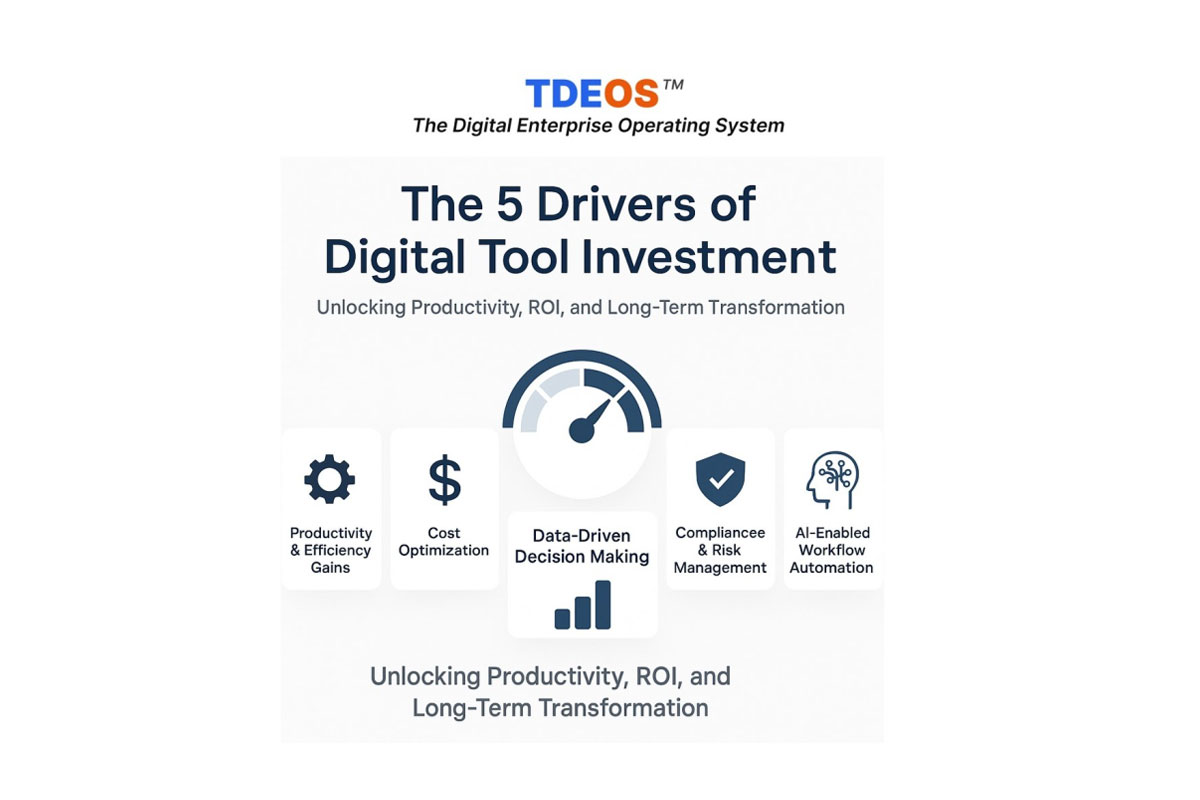
1. Productivity and Efficiency Gains – The Top Priority
Productivity improvements consistently rank as the primary driver for digital tool investments. Organizations are seeking to automate repetitive tasks, streamline workflows, and eliminate the friction that slows down daily operations. Modern ERP systems play a key role in transformation by integrating digital technology into all business functions to improve daily operations, boost revenue and increase competitiveness, all while increasing employee productivity.
HR leaders report that automation can reduce the time and resources required to manage tasks manually, while finance teams are leveraging AI to achieve a 40% reduction in both time and investment for technology projects.
2. Cost Optimization and Financial Performance
Organizations are under pressure to do more with less, making digital tools attractive for their ability to reduce operational costs while maintaining or improving service levels.
The financial case is compelling: In 2025, 75% of businesses using AI-powered HR solutions are projected to see at least a 10% increase in productivity, while ERP implementations can deliver significant cost savings through process automation and improved resource allocation.
3. Data-Driven Decision Making
Access to real-time, accurate data has become critical for business success. Organizations require instant access to accurate and actionable data to make informed decisions, driving investments in platforms that can provide comprehensive analytics and insights.
COOs & CFOs can position their companies for successful outcomes by fostering cross-functional alignment and enabling data-backed decision-making, making data capabilities a key factor in tool selection.
4. Compliance and Risk Management
Regulatory compliance continues to drive significant technology investments, particularly in finance and HR functions. Organizations need tools that can automate compliance processes, maintain audit trails, and adapt to changing regulatory requirements.
When the volume and pace of regulatory change increases, compliance risk is heightened, which can lead firms to divert resources from core business functions to regulatory compliance activities, making automated compliance tools essential.
5. AI-Enabled Workflow Automation
This emerging category is becoming a critical investment priority across all functions. Organizations are implementing AI to automate routine tasks, improve decision-making processes, and enhance operational efficiency. Early adopters report 20% productivity improvements in software development when using AI-assisted tools, while generative AI applications are showing potential for 40% reductions in both time and investment for complex business processes like cloud migration.
Technology-Specific Investment Patterns
CRM Technology: The CRM market is experiencing explosive growth, expected to reach $262.74 billion by 2032 with a CAGR of 12.8%. Organizations are prioritizing pipeline visibility, forecasting capabilities, and capturing intent data with lead scoring. Mobile CRM adoption is particularly strong, with 65% of companies using mobile CRM achieving their sales quotas compared to only 22% using non-mobile solutions.
HR Technology: Organizations are prioritizing Performance Management tools and Employee Recognition & Rewards systems. The focus is on improving employee experience, reducing turnover, and enabling better talent management. AI-powered HR solutions are projected to deliver at least 10% productivity increases for 75% of businesses by 2025.
Finance Technology: CFOs are emphasizing strategic cost reduction as a top priority for nearly 60% of finance leaders, while investing heavily in automation and AI to improve forecasting accuracy and reduce manual processes. Within the next 24 months, 70% of CFOs expect to use AI, machine learning, and robotic process automation to assist in forecasting duties.
ERP Systems: The global ERP software market is projected to grow from $92.6 billion in 2025 to $229.79 billion by 2032, driven by organizations seeking integrated platforms that can unify business processes and provide comprehensive operational visibility. Modern ERP systems are increasingly incorporating AI, IoT, and advanced analytics to drive business innovation and efficiency.
The ROI Reality Check
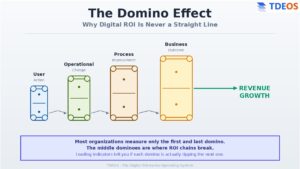
While the drivers are clear, achieving positive ROI requires careful planning and execution. ROI for technology can be categorized as Anticipated ROI and Actual ROI, and organizations must be realistic about both the costs and timeline for realizing benefits.
Success factors include:
- Clear measurement of productivity gains
- Proper change management and user adoption
- Integration with existing systems and processes
- Ongoing optimization and refinement
The TDEOS Approach to Digital Tool Investment
At TDEOS, we’ve observed that the most successful digital tool investments are those that align with a comprehensive digital operating model. Our The Digital Enterprise Operating System (TDEOS) framework addresses the critical gap between technology implementation and business value through three integrated pillars:
1. Enterprise Digital Strategy: Creating a compelling digital vision that directly connects business objectives to technology enablement, ensuring investments align with long-term strategic goals.
2. Digital Enterprise Operating Model: Building the organizational capabilities needed for successful execution, including governance structures, capability development, and change management processes.
3. Value Measurement System: Establishing real-time tracking of business impact metrics to ensure investments deliver their promised returns.
Organizations implementing the TDEOS framework typically achieve:
- 25-35% higher ROI on digital investments
- 40-60% reduction in time from concept to value realization
- 60-70% higher adoption rates of new digital capabilities
- 45-55% faster course correction when initiatives drift from value targets
Implications for Leaders
The research reveals several key insights for executives considering digital tool investments:
Think Ecosystem, Not Point Solutions: Tool decisions should focus on the need to connect systems as much as the capabilities they each bring. Organizations that take an integrated approach see higher returns on their technology investments.
Prioritize User Experience: Tools that are difficult to use or poorly integrated with existing workflows fail to deliver promised productivity gains. The more comfortable employees are in accessing the platform, the more likely they are to use it.
Focus on Foundation First: Forty percent of respondents are investing in the foundations for a robust data estate—data architecture, data management, and data insights. Without solid data foundations, advanced technologies like AI cannot deliver their full potential.
At TDEOS, we believe the future belongs to organizations that can balance immediate productivity needs with longer-term transformation goals. Our Digital Enterprise Maturity Assessment helps organizations understand where they stand across five critical dimensions: Leadership & Strategy, Technology & Infrastructure, Organizational Culture & Capabilities, Operational Processes & Innovation, and Customer & Market Engagement.
Start with our complimentary Digital Readiness Assessment to understand exactly where you need internal ownership versus external partnership.
This assessment provides the foundation for creating a comprehensive digital strategy that ensures tool investments create sustainable competitive advantages rather than just short-term efficiency gains.
What factors are driving your organization’s digital tool investments? Share your experiences and insights in the comments below.
The Digital Enterprise Newsletter is published weekly, delivering insights on enterprise evolution, business strategy, and value realization. Subscribe for strategic perspectives that help you navigate the complexity of technology-driven change.
TDEOS™ – The Digital Enterprise Operating System Bridging the gap between technology implementation and business impact www.tdeos.com