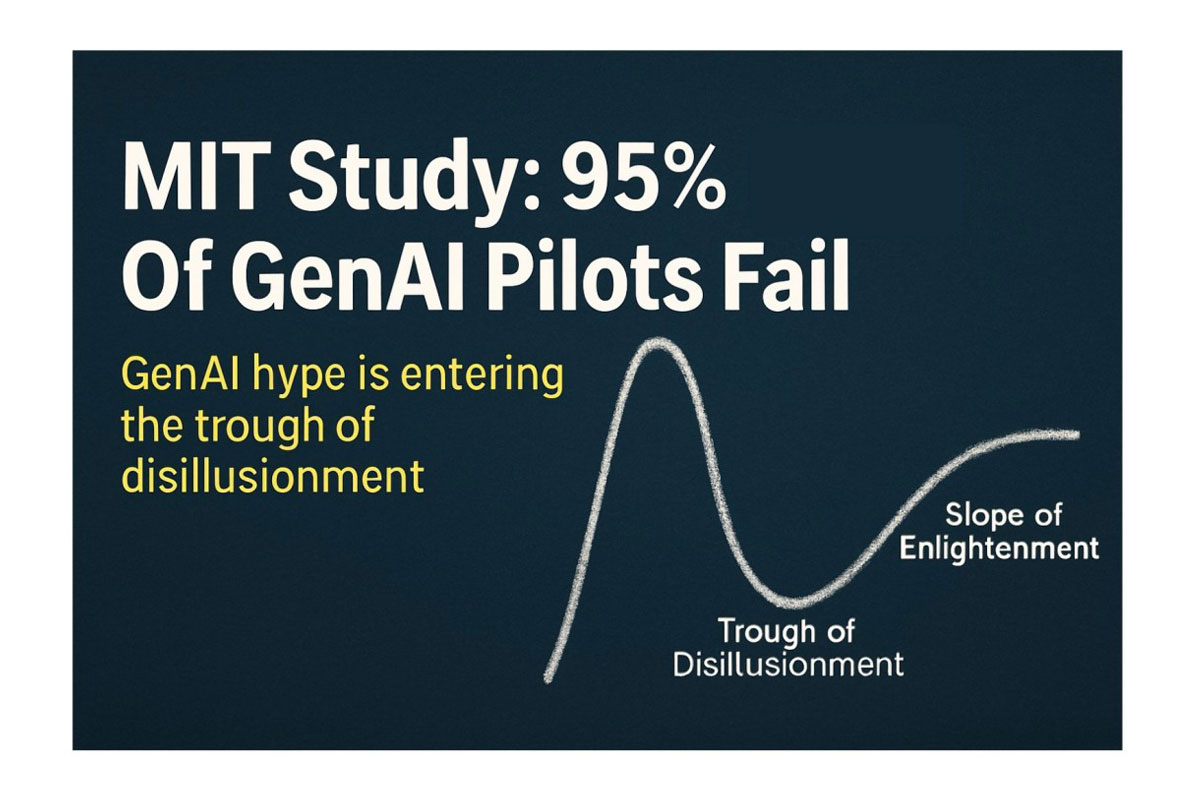
MIT Study Confirms What We Already Knew! GenAI hype is entering the trough of disillusionment.
Welcome to this edition of The Digital Enterprise, where we explore how companies can turn digital ambition into measurable outcomes.
This week, we dive into the MIT study that confirms what I’ve been seeing in the field: despite $30-40 billion in enterprise GenAI investment, 95% of initiatives fail to deliver measurable business impact. The study, from MIT’s Project NANDA, reveals the stark divide between AI hype and reality. More importantly, it shows us exactly why most organizations struggle while a select few achieve breakthrough results.
Bottom Line Up Front: The MIT findings aren’t surprising to those of us in the business transformation trenches. GenAI success today is limited to individual productivity gains, or requires either massive enterprise investment with extensive change management. For the majority of organizations, meaningful returns remain elusive without a process-first tech agnostic approach.
The MIT Study That Spooked Investors (But Shouldn’t Have Surprised Anyone)
MIT’s NANDA (Networked Agents and Decentralized AI) initiative released “The GenAI Divide: State of AI in Business 2025” in July 2025, and the findings sent shockwaves through the investment community. Based on 150 interviews with enterprise leaders, surveys of 350 employees, and analysis of 300 public AI deployments, the study revealed a stark reality:
95% of enterprise GenAI pilot programs fail to generate measurable financial returns.
The research, led by Aditya Challapally and Professor Ramesh Raskar at MIT Media Lab, found that only 5% of AI pilot programs achieve rapid revenue acceleration, while the vast majority stall with little to no impact on profit and loss statements.
Understanding Project NANDA’s Perspective
Project NANDA (Networked Agents and Decentralized AI) is MIT’s ambitious initiative to build foundational infrastructure for autonomous AI agents to collaborate across a decentralized web. As part of this broader vision for an “Internet of AI Agents,” the research naturally examines current enterprise AI limitations through the lens of their proposed solution: agentic AI systems that can learn, remember, and adapt over time.
From NANDA’s perspective, today’s enterprise AI failures stem from a fundamental “learning gap.” Current tools don’t retain data, don’t adapt to workflows, and don’t improve with feedback. This creates a cycle where users abandon enterprise AI tools for sensitive or high-stakes work, despite finding consumer tools like ChatGPT useful for general tasks.
While NANDA’s research is methodologically sound, it’s worth noting their solution points toward their own agentic AI framework. However, the core findings align with what I’ve been observing across hundreds of enterprise implementations.
Why These Results Aren’t Surprising
Having led technology initiatives across Fortune 500 companies for over two decades, these MIT findings confirm patterns I’ve witnessed repeatedly. The 95% failure rate isn’t shocking, it’s predictable.
The Current Success Pattern Is Narrow and Limited
GenAI success today falls into three distinct categories, each with inherent limitations:
- Individual Productivity: AI augments the expertise of professionals who can immediately recognize good outputs from hallucinations. A senior attorney using AI to draft contracts, a seasoned developer using Copilot for code generation, or an experienced analyst using AI for research all see immediate productivity gains because their expertise acts as a quality filter. Entry-level employees gain dramatic productivity improvements through AI guidance for tasks they’re still learning. Customer support representatives, junior analysts, and new hires in various fields can achieve near-expert performance quickly with AI assistance.
- Enterprise Scale with Massive Investment: Large enterprises with substantial resources can achieve AI success through comprehensive change management, extensive training, and enterprise-wide process redesign. However, this requires millions in investment and months of organizational transformation.
- Small Organization Agility: Startups and small companies can pivot quickly around AI capabilities because they have fewer entrenched processes, less organizational inertia, and simpler change management requirements.
The problem is that most organizations don’t fit these success patterns.
The Missing Middle: Mid-size companies lack the resources for comprehensive enterprise transformation but have too much complexity for startup-style agility. They’re caught in the “missing middle” where AI pilots consistently fail to scale.
The Real Reasons Behind AI Pilot Failures
The MIT study identifies several key failure patterns that align perfectly with what we see in the field:
The Learning Gap Problem
MIT Finding: Generic tools like ChatGPT excel for individuals because of flexibility, but stall in enterprise use since they don’t learn from or adapt to workflows.
Field Reality: Organizations buy AI tools expecting them to automatically understand complex business processes, regulatory requirements, and institutional knowledge. When the tools can’t adapt to these nuances, users abandon them for familiar alternatives.
Misaligned Resource Allocation
MIT Finding: More than half of GenAI budgets go to sales and marketing tools, yet the biggest ROI comes from back-office automation.
Field Reality: Organizations chase revenue-generating applications while ignoring the operational efficiency gains that would provide more immediate and measurable returns.
Build vs. Buy Disconnect
MIT Finding: Purchasing AI tools from specialized vendors succeeds 67% of the time, while internal builds succeed only one-third as often.
Field Reality: Organizations try to build custom AI solutions without understanding the complexity involved, leading to delayed deployments and suboptimal performance.
Central Lab vs. Line Manager Adoption
MIT Finding: Success requires empowering line managers, not just central AI labs, to drive adoption.
Field Reality: IT-driven AI initiatives often fail because they don’t address the actual workflow needs of business users who ultimately determine adoption success.
The Process-First Solution
The MIT study confirms what I’ve learned through hundreds of implementations:
AI success isn’t about having the most advanced technology. It’s about having the organizational foundation to effectively integrate and adopt AI capabilities.
Success requires a technology-agnostic approach focusing on process redesign before tool selection, systematic change management for sustainable adoption, and integration architectures that support workflow evolution. The companies in the successful 5% understand that AI is just one piece of a larger transformation puzzle that includes process reengineering, outcome definition, capability building, and comprehensive change management.
Ready to Join the Successful 5%?
Don’t become another AI failure statistic. Schedule a complimentary AI Readiness Assessment to evaluate your organization’s capability for successful AI implementation using proven process-first methodologies.
Book Your AI Readiness Assessment
In this session, we’ll:
- Evaluate your current AI initiatives against the MIT success factors and failure patterns
- Assess your organizational readiness for AI adoption using the TDEOS process-first framework
- Identify workflow optimization opportunities that create foundation for AI success
- Design a roadmap for AI implementation that addresses the “learning gap” MIT identified
- Show you exactly how to avoid the 95% failure rate through systematic process and change management
Limited to 2 sessions per month. Book now to secure your spot.
Share your AI implementation experiences. Are you seeing the patterns MIT identified? What’s working versus what’s stalling in your AI initiatives?
The Digital Enterprise newsletter is published weekly, delivering actionable insights for technology and business leaders navigating AI implementation and enterprise technology initiatives. Subscribe for frameworks, case studies, and proven methodologies that drive measurable business value.