Why rushing transformation kills ROI and how patient leaders achieve 5x results
Welcome to this edition of The Digital Enterprise, where we explore how companies can turn digital ambition into measurable outcomes.
This week, we tackle the most dangerous myth in enterprise technology: that transformation should deliver results immediately. Leaders are pressuring teams for quarterly wins from AI initiatives that need years to mature. The result? Rushed implementations, abandoned projects, and billions in wasted investment. Nature teaches us that real growth requires patience, and your transformation is no different.
Bottom Line Up Front:
The organizations achieving breakthrough results from AI and technology initiatives are those willing to invest in long-term change over short-term wins. Just as nine women can’t deliver a baby in one month, sustainable transformation cannot be rushed. Companies that embrace multi-year transformation timelines achieve 5x higher ROI than those chasing quarterly results.
The Dangerous Rush for Instant Results
Every executive wants to see ROI from their technology investments immediately. Boards ask about AI impact in quarterly reviews. Leadership demands transformation results within fiscal years.
This pressure to show instant results creates a toxic cycle: teams rush implementations to show quick wins, which leads to shallow adoption, limited impact, and eventual abandonment.
Consider this example: A Fortune 100 manufacturing company invested $25 million in an AI-powered supply chain optimization platform. The CEO demanded visible results within six months. The implementation team focused on rapid deployment instead of process redesign and change management. They achieved technical success but organizational failure. Employee adoption remained below 30%, and supply chain efficiency improved by only 8% instead of the projected 35%.
The mistake wasn’t the technology choice, it was the timeline expectation. When the CEO asked for results in six months, the team optimized for speed instead of sustainability. They got quick implementation but failed transformation.
According to our analysis of 500+ technology initiatives, organizations that set realistic 18-24 month transformation timelines achieve 5x higher ROI than those demanding results in 6-12 months.
The math is clear: patience produces better outcomes.
Learning from Nature’s Wisdom
Nature provides perfect analogies for why transformation can’t be rushed:
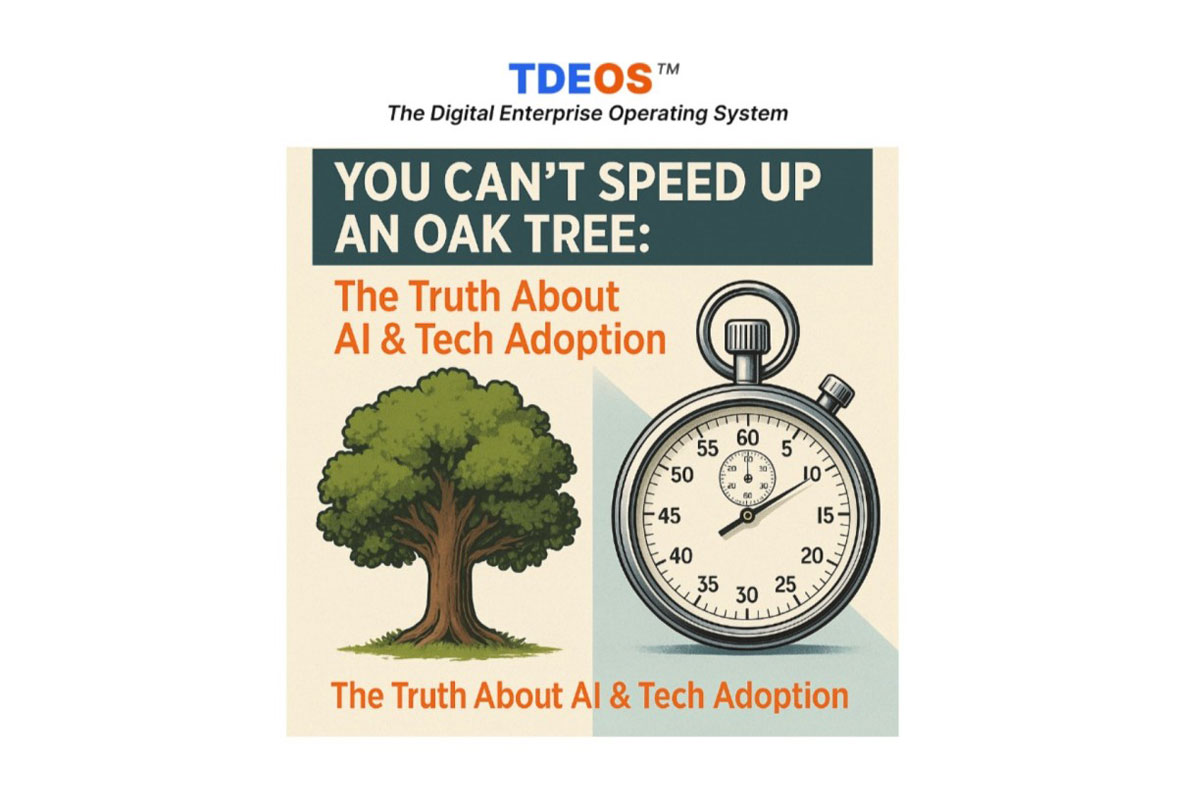
Oak trees grow slowly but live for centuries; bamboo grows quickly but needs replanting. Organizations can choose fast implementation with short-term impact or patient transformation with lasting competitive advantage. Most choose bamboo and wonder why their technology initiatives need constant replanting.
Nine women can’t deliver a baby in one month. Some processes have natural timelines that cannot be accelerated regardless of resources applied. Human behavior change, organizational culture shifts, and deep skill development all follow biological rhythms that resist artificial speed-ups.
Cooking meat at 900°F for one hour doesn’t equal cooking at 300°F for three hours. High heat burns the outside while leaving the inside raw. Similarly, rushing transformation creates surface-level changes that mask underlying resistance. You get the appearance of progress without sustainable transformation.
The Science of Sustainable Change
Research from behavioral psychology, organizational development, and change management consistently shows that meaningful change follows predictable patterns that cannot be rushed:
The 90-Day Rule
Human beings need approximately 90 days to develop new habits and behaviors. This isn’t cultural, it’s neurological. The brain literally rewires itself over this timeframe, creating new neural pathways that support changed behavior. Organizations that expect AI adoption or new process adherence in 30-60 days are fighting biology.
The Cultural Embedding Timeline
Organizational culture changes over 12-18 months, not quarters. New behaviors must be modeled, reinforced, measured, and celebrated repeatedly before they become “how we do things here.” Companies that expect cultural transformation in six months are setting themselves up for regression to old patterns.
The Capability Development Curve
Deep technical and business capabilities develop over years, not months. Becoming truly proficient with AI tools, advanced analytics, or new business processes requires thousands of hours of practice and application. Organizations that expect expert-level capability after basic training are destined for disappointment.
The Hidden Costs of Rushing Transformation
False Starts and Do-Overs: Organizations that rush transformation often end up starting over 12-18 months later when initial efforts fail to deliver. The total cost of rushed transformation followed by restarts is typically 2-3x higher than patient, well-planned initiatives.
Change Fatigue and Resistance: Employees who experience failed “transformation” initiatives become skeptical of future change efforts. This resistance makes subsequent initiatives significantly more difficult and expensive.
Shallow Adoption and Limited Impact: Surface-level implementations produce minimal business value while consuming significant resources. Organizations get the cost of transformation without the benefits.
Competitive Disadvantage: While you’re cycling through failed quick fixes, patient competitors are building sustainable capabilities that become increasingly difficult to match.
The TDEOS Transformation Timeline Framework
The TDEOS™ framework recognizes that sustainable transformation follows natural phases that cannot be artificially compressed:
Phase 1: Foundation Building (Months 1-6)
What Happens:
- Assessment and discovery of current state
- Strategy development and executive alignment
- Pilot implementations with willing early adopters
- Initial skills development and basic training
- Quick wins to build confidence and momentum
Why It Takes Time: Building trust, establishing new governance structures, and creating shared understanding cannot be rushed. Leaders need time to internalize new approaches. Teams need time to understand how technology fits their specific context.
Typical Value Realization: 5-15% of transformation potential
Phase 2: Capability Development (Months 6-18)
What Happens:
- Scaled implementation across key business domains
- Deep skills development and expertise building
- Process redesign and workflow optimization
- Cultural change initiatives and behavior reinforcement
- Measurement system implementation and refinement
Why It Takes Time: This is where real change happens. People develop new competencies, processes evolve around technology capabilities, and cultural shifts begin taking hold. Rushing this phase creates the illusion of progress while limiting actual transformation.
Typical Value Realization: 40-70% of transformation potential
Phase 3: Transformation Maturity (Months 18-36)
What Happens:
- Full organizational adoption and integration
- Advanced capability development and innovation
- Continuous optimization and value maximization
- Cultural embedding of new behaviors
- Platform for next-generation capabilities
Why It Takes Time: Deep expertise, cultural integration, and sustainable competitive advantage cannot be purchased or implemented quickly. They must be developed through consistent practice, refinement, and reinforcement over time.
Typical Value Realization: 100%+ of transformation potential (often exceeding original projections)
Building Your Patience Strategy
Setting Realistic Expectations
With Leadership: “Our AI initiative will show meaningful impact in 18-24 months. We’ll deliver quick wins to demonstrate progress, but sustainable transformation takes time. I need your commitment to this timeline for us to achieve the full potential.”
With Teams: “We’re building capabilities that will serve us for years, not quarters. Your investment in learning and change will pay dividends over time. We’ll measure progress continuously, but we won’t rush the process.”
With Stakeholders: “This transformation will make us a different company, not just a company with new technology. Different companies aren’t created overnight. We’re committing to the time required for real, lasting change.”
Creating Milestone-Based Progress
Rather than demanding immediate results, create meaningful milestones that demonstrate progress toward transformation:
Months 1-6: Foundation and Early Wins
- Baseline metrics established
- Quick wins implemented and measured
- Team capabilities assessment completed
- First pilot results demonstrating potential
Months 6-12: Capability Building
- Skills development milestones achieved
- Process improvements documented
- Technology adoption rates increasing
- Business impact metrics showing improvement
Months 12-18: Integration and Scale
- Cross-functional adoption achieved
- Business outcomes meeting projections
- Cultural changes becoming visible
- Platform ready for advanced capabilities
Months 18-24: Optimization and Innovation
- Sustainable competitive advantages evident
- Continuous improvement processes functioning
- Innovation opportunities identified and pursued
- Transformation objectives achieved or exceeded
Ready to Build Sustainable Transformation?
Stop chasing quarterly wins and start building lasting competitive advantage. Schedule a complimentary Transformation Timeline Strategy Session to develop a realistic roadmap that balances quick wins with sustainable change.
Book Your Strategy Session Now!
In this 60-minute session, we’ll:
- Assess your current transformation timeline expectations and risks
- Identify where patience would accelerate your long-term results
- Design a milestone-based roadmap that demonstrates progress while building lasting capability
- Show you exactly how leading organizations achieve 5x higher ROI through patient transformation
Limited to 3 sessions per month. Book now to secure your spot.
The Digital Enterprise Newsletter is published weekly, delivering insights on enterprise evolution, business strategy, and value realization. Subscribe for strategic perspectives that help you navigate the complexity of technology-driven change.
TDEOS™ – The Digital Enterprise Operating System Bridging the gap between technology implementation and business impact www.tdeos.com