
What Are Shadow CRM Systems and Why Teams Build Them
Quick Answer
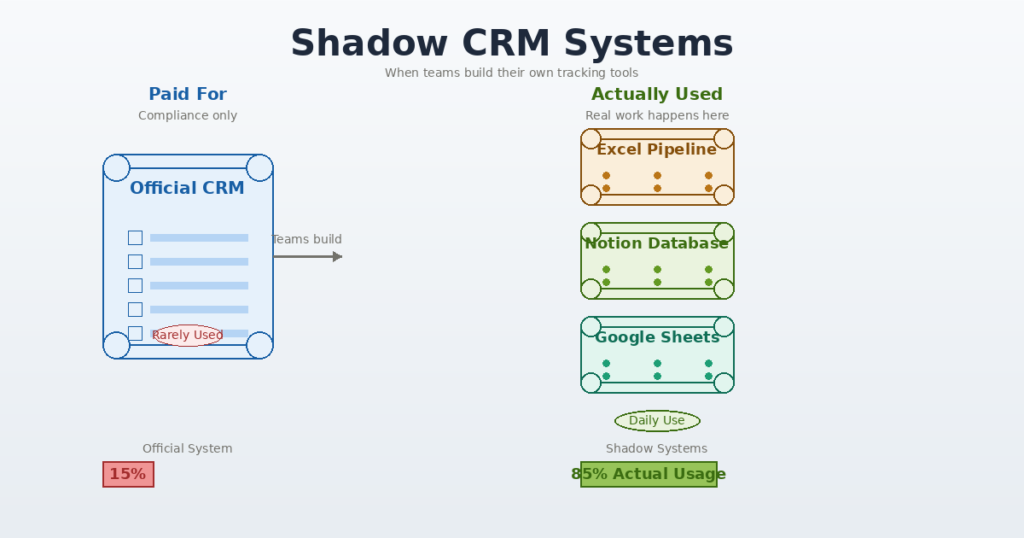
Shadow CRM systems are tracking tools teams build outside the official CRM—Excel spreadsheets, Notion databases, Google Sheets, personal tracking systems—that contain more current and trusted data than the official CRM. They emerge when the official system doesn’t match how work actually happens, is too complex to use, or can’t be trusted for daily decisions. Shadow CRMs are a symptom of system failure, not user rebellion. They reveal gaps between how the CRM is configured and how work actually gets done.
How Shadow CRM Systems Emerge
Week 1-4: The Personal Workaround
A top performer creates a simple spreadsheet to track something the CRM doesn’t capture well. It’s just for them. Nobody else knows about it.
Month 2-3: The Team Adopts It
Colleagues see the spreadsheet works better than the official system. They ask for a copy. Now three people are maintaining the same workaround.
Month 4-6: It Becomes Infrastructure
The spreadsheet gets shared in Slack. New team members are told “here’s the real tracker.” The official CRM becomes where you log activity after consulting the shadow system.
Month 6+: The Shadow System IS the System
Leadership starts asking for reports from the shadow system instead of the CRM. The official platform exists for compliance. The shadow system runs the business.
What Are Shadow CRM Systems
You’re in a customer call. Your rep has three windows open.
- One is Salesforce. That’s the official system. The record shows the account status, last logged activity, deal stage.
- One is Excel. That’s where the actual pipeline lives. The rep updates it after every call because it has the information they actually need to do their job.
- One is Notion. That’s where the account strategy lives. The CRM doesn’t have fields for the context that matters.
Which system is the real CRM? The one the rep actually uses to make decisions.
That’s a shadow CRM.
Shadow CRM systems aren’t acts of rebellion. They’re acts of survival.
When your official CRM doesn’t give teams the information they need to do their jobs effectively, they build something that does. When the official system is too complex to use during a customer conversation, they create something simpler. When leadership doesn’t trust CRM reports, they maintain separate trackers they can actually rely on.
The official CRM becomes compliance infrastructure. Log your activities there because it’s required. But make your actual decisions based on the shadow system because that’s where the real information lives.
This is different from poor adoption. Poor adoption means nobody uses the CRM at all. Shadow systems mean people are using something—just not the system you paid for.
The existence of shadow CRMs tells you three things:
- Your official CRM has failed to serve a real need
- Your team is resourceful enough to solve problems themselves
- The gap between “official system” and “actual workflow” is wide enough that people will maintain two systems rather than rely on the broken one
Why Shadow CRM Systems Form
The Official CRM Doesn’t Capture What Matters
Your sales team needs to know which accounts have contract renewal dates in Q3, which decision-makers recently changed roles, and which deals are at risk because budget got redirected.
Your CRM has custom fields for industry classification (that nobody fills in), lead source (that everyone marks as “other”), and forecast category (that requires six clicks to update).
The information teams need isn’t in the system. So they track it somewhere else.
The Official System Is Too Slow for Real Work
A rep is on a customer call. The customer asks about past conversations with your support team.
Pulling that information from the CRM requires:
- Switching from the call to the browser
- Finding the account (hoping it’s not a duplicate)
- Clicking through three tabs to find activities
- Scrolling through unfiltered logs to find relevant ones
- Interpreting cryptic abbreviations from support tickets
Or the rep can check their personal notes document where they wrote it down in plain language last time.
Which one gets used during the call?
The official system becomes post-call documentation. The shadow system is the operational tool.
The Data in the CRM Can’t Be Trusted
Your VP of Sales pulls a pipeline report. It shows $8 million.
They know from conversations with reps that three “committed” deals aren’t actually committed. Two accounts marked as “qualified” haven’t responded in weeks. One deal marked as 90% probability is actually stalled on budget approval.
So the VP maintains their own spreadsheet where they track the real status. They ask reps for weekly updates to the spreadsheet. The CRM stays out of sync because nobody trusts it for decisions.
When leadership doesn’t trust the official system, they build their own. That’s a shadow CRM at the executive level.
The CRM Requires Information Teams Don’t Have
Your CRM requires 18 fields to be filled before moving a deal to “qualified.”
Problem: most of those fields require information your team doesn’t have during the first conversation. Company size? Don’t know yet. Budget? Haven’t discussed it. Decision timeline? That’s the conversation you’re trying to schedule.
So reps either:
- Fill fields with placeholder text just to move the deal forward (polluting your data)
- Keep deals in early stages longer than reality (making pipeline reports wrong)
- Track deals in Excel where they can write “promising first call, budget conversation next week” without artificial field requirements
The shadow system emerges because the official system’s requirements don’t match the realities of how deals actually progress.
Nobody Can Say No to Complexity
Sales wants custom fields to track their metrics. Marketing needs different pipeline stages. Customer Success requests their own module. Finance needs ERP integration.
Each department gets what they asked for. The CRM becomes a collection of features that individually make sense but collectively create a system so complex nobody can use it.
So each department maintains their own simplified tracker. Three shadow systems replace one official CRM.
The official system became everything to everyone, which made it useful to no one.
Common Signs of Shadow CRM Systems
You see shadow CRMs in these patterns:
Links shared in Slack instead of CRM links.
When coordinating on an account, team members share Google Sheet links or Notion pages. CRM links are only shared when HR or compliance asks for documentation.
Top performers have the best workarounds.
Your most effective reps maintain the most sophisticated personal tracking systems. They’ll show new hires “the real tracker” within their first week. The official CRM isn’t mentioned until IT orientation.
Leadership asks for “the real numbers.”
When your CEO needs pipeline for the board, they don’t pull a CRM report. They ask the VP of Sales to send them “the actual spreadsheet.” Everyone knows which one they mean.
Onboarding includes unofficial tools.
New employees get trained on the official CRM by HR. Then their manager shows them the Excel file, Notion database, or Google Sheet they’ll actually use. This is presented as “here’s how we really do it.”
Reports get rebuilt in Excel.
Someone exports CRM data, then spends two hours reformatting it in Excel because the CRM’s version is unusable. The same report gets rebuilt manually every week. Nobody questions this.
Critical information lives in email or chat.
The most important context about an account—why they bought, what almost went wrong, what promises were made—lives in Slack threads or email, not in the CRM. Because there’s no good place to put it in the official system.
Duplicate work is normalized.
Reps update their personal tracker after a call, then log the activity in the CRM to satisfy reporting requirements. Nobody considers this waste because “that’s just how it works here.” Three hours per week per rep is accepted as overhead.
System downtime doesn’t stop work.
When the CRM goes down for maintenance, work continues normally. Teams use their shadow systems. The only complaint is “now we have to backfill the CRM when it comes back up.” If work stopped when the CRM went down, you’d know people actually depended on it.
Real-World Example
I worked with a financial services firm that had spent $180,000 implementing Salesforce for their 60-person team.
Adoption metrics looked good: 78% daily login rate. But nobody was making decisions based on CRM data.
What we found:
The sales team maintained a shared Google Sheet called “Actual Pipeline.” It had 12 columns. Every rep knew exactly what each column meant. They updated it after every customer interaction.
The customer success team maintained a Notion database for renewals. It tracked relationship status, contract details, and risk factors using plain language descriptions. It was updated in real-time during customer calls.
The VP of Sales maintained their own Excel file for board reporting. It consolidated data from the sales Google Sheet, the CS Notion database, and their own weekly check-ins with team leads.
Meanwhile, Salesforce had:
- 87 custom fields on the opportunity object
- 43 custom fields on the account object
- 7 different pipeline stages that nobody could explain the difference between
- Automated workflows that sent notifications nobody read
- Dashboards that showed data nobody trusted
When asked why they didn’t use Salesforce, the response was consistent: “It doesn’t have what we need, and it has too much we don’t need.”
The fix:
We didn’t force Salesforce adoption. We asked: what information do you actually need to make decisions?
The answer: 8 fields for opportunities, 6 fields for accounts, 3 pipeline stages.
We rebuilt the system around those fields. Everything else was removed. The shadow systems disappeared within two months because the official system finally served the actual need.
Annual savings: $45,000 in reduced Salesforce licensing by moving to a simpler platform. Productivity improvement: 4 hours per week per rep by eliminating duplicate tracking.
The problem wasn’t that people wouldn’t use the CRM. The problem was that the CRM wasn’t designed for how they actually worked.
Business Impact of Shadow CRM Systems
Shadow CRMs create three major problems:
You’re paying twice. You’re paying for the official CRM in licensing costs, admin time, and integration maintenance. And you’re paying for shadow systems in the time teams spend maintaining parallel trackers. A 10-person sales team spending 4 hours per week on duplicate tracking costs $50,000-$80,000 per year in lost productivity. Plus the $30,000-$100,000 in CRM licensing and admin time. You’re funding two systems and getting the problems of both.
Leadership makes decisions on partial data. When shadow systems proliferate, information fragments. Sales pipeline is in Excel. Customer health is in Notion. Support history is in email. Product usage is in a BI tool. Nobody has the complete picture. Leadership makes decisions based on whichever shadow system they happen to have access to. Critical connections between data points get missed because the information isn’t in one place.
AI initiatives fail before they start. Your executive team wants AI for lead scoring, churn prediction, and revenue forecasting. But AI trains on the data in the official CRM. If the real information lives in shadow systems, the AI learns from incomplete or wrong data. The predictions it makes don’t match reality because reality isn’t in the system the AI can see. You can’t deploy AI on top of a system nobody actually uses.
The Relationship Between Shadow CRM and CRM Drift
Shadow CRMs are the visible symptom of CRM drift.
CRM drift is the gradual deterioration of the official system—when it stops matching how work gets done, complexity accumulates, and leadership stops trusting the data.
Shadow CRMs are what teams build in response to that drift.
The timeline typically looks like this:
Months 1-3 after go-live: No shadow systems yet. The official CRM is new and working well enough.
Months 4-6: First shadow systems appear. One or two top performers create personal trackers. These are individual workarounds, not systemic yet.
Months 7-12: Shadow systems proliferate and formalize. Multiple team members adopt the same workarounds. These get shared in Slack, documented in onboarding. CRM drift is now advanced.
12+ months: Shadow systems are the primary operational tools. The official CRM exists for compliance reporting. Leadership makes decisions based on shadow data, not CRM reports.
You can’t eliminate shadow CRMs through enforcement or policy. They exist because they solve a real problem. The only way to eliminate them is to make the official CRM more useful than the shadow system.
That means fixing the underlying drift: simplifying the official system, aligning it with actual workflows, and rebuilding trust in the data.
How to Eliminate Shadow CRM Systems
Don’t Start by Banning Them
The shadow system exists because it works better than the official system.
Banning it without fixing the underlying problem just creates hidden shadow systems. Teams will still maintain workarounds—they’ll just stop talking about them in Slack.
Instead, start by understanding what the shadow system does that the official system doesn’t.
Interview the Shadow System Creators
Talk to the people who built the shadow systems. Ask:
- What information do you track here that the CRM doesn’t have?
- What makes this easier to use during customer conversations?
- What decisions do you make using this that you can’t make with the CRM?
- If we could add one thing to the official system, what would it be?
The answers tell you exactly what’s missing from your CRM.
Simplify the Official System First
Before adding what’s missing, remove what’s not being used.
Shadow systems are usually simple. They have 5-10 fields that matter. The official CRM has 50+ fields that clutter the interface.
The first step is making the official system as simple as the shadow system. Remove unused fields. Delete obsolete workflows. Archive reports nobody opens.
Only after simplification do you add what’s missing. Adding features to an already complex system makes it worse, not better.
Migrate What’s Valuable, Discard What’s Not
The shadow system might have valuable historical data. Or it might just have the last three months that matter.
Don’t try to migrate everything. Figure out what’s actually valuable.
Often, the answer is: migrate active records only. The rest was documentation that nobody will reference again anyway.
Make Migration Easy, Not Mandatory
Give teams a migration path, not a mandate.
“Here’s how to import your data if you want to. Here’s the simplified CRM that now has the fields you were tracking in Excel. Try it for two weeks. If it works better than your spreadsheet, migrate. If not, tell us what’s still missing.”
Voluntary adoption based on the system being better. Not forced adoption based on policy.
Rebuild Trust Through Consistency
Leadership stopped trusting the official CRM because it was wrong too many times.
You rebuild trust by delivering on small commitments consistently.
Start with one report that leadership needs. Make sure it’s accurate. Deliver it weekly. Prove the official system can be trusted for this one thing.
Then expand. One more report. One more decision they can rely on the CRM for.
Trust returns gradually. It can’t be mandated.
Establish Ownership of System Health
Someone needs to own “does the CRM match how work actually happens?”
Not the admin who maintains fields. Not IT who manages infrastructure. Someone with authority to say no when a department requests a feature that will create complexity without adding value.
In mid-market companies, this is usually COO, VP of Operations, or Head of Revenue Operations.
Without this ownership, shadow systems will return. Because the official system will drift again, and teams will build workarounds again.
Governance prevents recurrence.
Why Shadow CRMs Happen More Often in Mid-Market Companies
Enterprise companies have resources to prevent shadow systems from forming.
They have dedicated CRM admins who can configure the system to match team needs. They have revenue operations teams who monitor data quality. They have change management processes that catch problems early.
Mid-market companies (50-500 employees) don’t have those resources.
Your operations person manages the CRM in addition to their other responsibilities. When teams request changes, there’s nobody with time to implement them properly. When shadow systems emerge, there’s nobody monitoring for them.
By the time leadership notices—usually when they’re trying to make a decision and realize they can’t trust the CRM data—shadow systems are deeply embedded in team workflows.
This is why mid-market companies see shadow CRMs more often. Not because they make worse technology decisions. Because they don’t have the resources to keep the official system aligned with evolving business needs.
The solution isn’t to hire enterprise-level resources. The solution is to choose systems simple enough that they don’t require enterprise-level resources to maintain.
Systems where your operations generalist can make configuration changes themselves. Systems where simplicity is the default, not complexity. Systems where teams actually want to use the official tool instead of building workarounds.
If This Sounds Familiar
Your teams aren’t rejecting the CRM. They’re solving a real problem the official system created.
Start with a CRM Assessment to understand what your shadow systems reveal about what’s broken in the official one.
Schedule a CRM Health Assessment: https://tdeos.com/crm
Or discuss your specific situation: https://tdeos.com/#get-in-touch
Frequently Asked Questions About CRM Drift
Q: Are shadow CRM systems always bad?
A: Not always. Sometimes they reveal legitimate gaps in your official CRM that need to be addressed. The problem is when they become the primary source of truth, undermining the official system’s credibility and creating data silos that prevent organization-wide visibility.
Q: How do you know if your team is using shadow CRMs?
A: Watch for these signals: reps reference spreadsheets during customer calls, people share Google Sheet links in Slack instead of CRM links, leadership asks for “the real numbers” rather than pulling CRM reports, or your top performers have built sophisticated tracking systems that nobody talks about in meetings.
Q: Can you eliminate shadow CRMs through policy?
A: No. Banning shadow systems without fixing the underlying problem just creates hidden workarounds. The only way to eliminate shadow CRMs is to make the official system more useful than the shadow system—either by adding missing capabilities, removing unnecessary complexity, or both.
Q: Why do shadow CRMs emerge months after go-live?
A: Initially, teams give the official CRM a chance. Shadow systems emerge when teams realize the official system doesn’t match how work actually happens, is too complex for daily use, or can’t be trusted for decisions. This realization typically occurs 4-6 months after implementation once teams have tried working within the system’s constraints.
Q: What’s the difference between shadow CRM and poor adoption?
A: Poor adoption means nobody uses the CRM at all. Shadow CRM means people are actively tracking work—just not in the official system. Shadow systems indicate the team is motivated to track information properly; they’ve just concluded the official CRM isn’t the right tool for it.
Q: How much do shadow CRM systems cost?
A: You’re paying twice: official CRM licensing and admin time ($30K-$100K+/year) plus team time maintaining parallel trackers (4+ hours per week per person = $50K-$80K/year for a 10-person team). Total cost: $80K-$180K/year for maintaining two systems while getting the problems of both.
About TDEOS
TDEOS helps mid-market companies fix broken CRM systems and eliminate shadow CRM proliferation.
We work with organizations (50-500 employees) in healthcare, nonprofits, financial services, and professional services that invested in a CRM but aren’t getting ROI.
Common situations we address:
- Teams maintaining Excel/Google Sheets/Notion instead of using official CRM
- Official system too complex for daily operational use
- Leadership doesn’t trust CRM reports, maintains their own trackers
- Shadow systems have become the actual source of truth
- Trying to eliminate shadow systems through policy isn’t working
Founder: Raman Arora
Background: 22+ years Fortune 500 operations at GE Aviation, Dell, and Paycor leading CRM implementations, revenue operations, and digital transformation initiatives.
Approach: Eliminate shadow CRMs by understanding what they reveal about gaps in the official system, simplifying complexity, and rebuilding trust in centralized data.
Location: Cincinnati, Ohio (serving nationwide)
Contact: https://tdeos.com/contact-us
LinkedIn: https://www.linkedin.com/in/ra-arora
Clutch Verified Reviews: https://clutch.co/profile/tdeos
Related Resources
Articles on CRM Problems:
CRM Drift: Why CRM Systems Fail After Implementation
https://tdeos.com/crm/crm-drift/
Why Leadership Stops Trusting the CRM
https://tdeos.com/when-leadership-stops-trusting-the-crm/
The Year After Go-Live: Why CRM Success Turns Into Struggle
https://tdeos.com/the-year-after-go-live-why-crm-success-turns-into-crm-struggle/
AI CRM Limitations: Pattern Recognition vs Understanding
https://tdeos.com/insights/