
What Is CRM Drift and Why CRM Systems Fail Over Time
Quick Answer
CRM drift is the gradual deterioration of a CRM system after implementation. It happens when the system stops matching how work actually gets done, teams build workarounds outside the CRM, and leadership stops trusting the data. Within 12 to 18 months, what looked like a successful implementation becomes an expensive system that nobody genuinely uses. The result: millions of dollars in wasted investment and decisions made without reliable data.
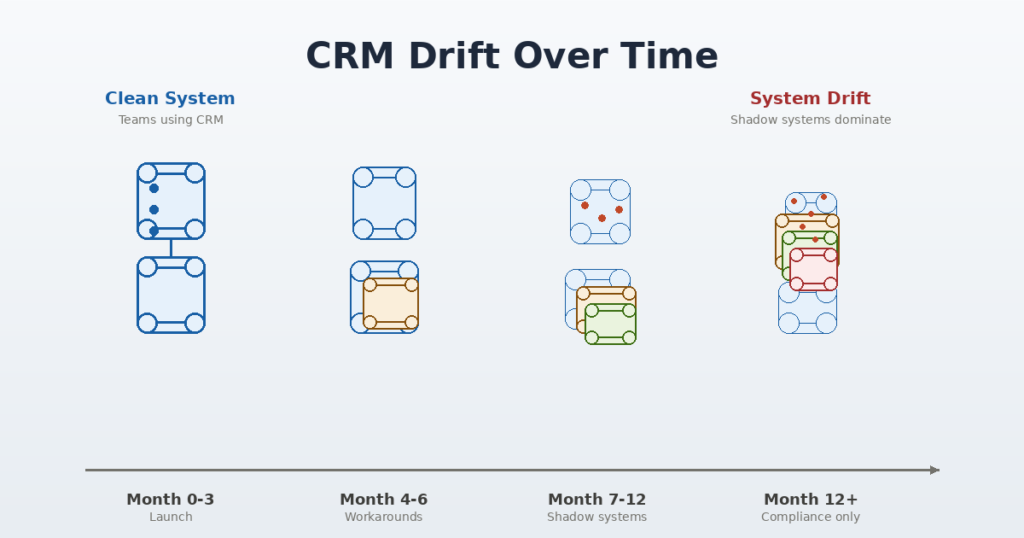
How CRM Drift Happens Over Time
- Months 1–3: The Honeymoon
High adoption (85%+). Clean data. Teams logging in. Leadership optimistic. Dashboards look good. - Months 4–6: Early Warning Signs
Workarounds begin. A few Excel files appear. Nobody mentions them. Data quality starts slipping quietly. - Months 7–12: Shadow Systems Take Over
Teams share Google Sheet links instead of CRM links. Top performers maintain personal tracking systems. These shadow CRMs become the actual source of truth while the official system becomes compliance theater. Forecast accuracy declining. - 12+ Months: Compliance Theater
CRM exists to satisfy requirements, not inform decisions. Leadership asks for “real numbers” in spreadsheets. Teams log minimum activity to stay compliant.
What Is CRM Drift
CRM drift starts quietly.
Three months after go-live, your CRM looks like a success. Adoption is at 85%. Teams are logging in. Dashboards show clean data. Leadership is optimistic.
Twelve months later, something has changed.
Your sales team maintains their own Excel files. Customer success tracks renewals in Notion. Leadership asks for “the real numbers” instead of pulling CRM reports. Data quality has declined so much that forecasts are consistently wrong.
The system didn’t break. It drifted.
CRM drift is what happens when a CRM implementation succeeds technically but fails operationally. The system works as designed. But the design no longer matches how your business actually operates.
Fields that made sense at implementation are now unused. Workflows built for an idealized process don’t fit the messy reality of how deals actually close. Integrations that were supposed to reduce manual work have created new complexity.
Nobody decided to stop using the CRM. Teams didn’t rebel against it. The system just slowly became less useful than the workarounds people built around it.
This is different from a failed implementation. Failed implementations never get adopted in the first place. CRM drift happens to systems that worked initially but couldn’t keep pace with how the business actually operates.
Why CRM Drift Happens
Nobody Owns It After the Consultant Leaves
Most CRM implementations focus entirely on the launch.
Configure the fields. Build the workflows. Train the users. Go live. The consultant moves on to the next client.
But who owns the CRM after go-live? In most mid-market companies, the answer is unclear.
IT built it but doesn’t understand the business logic. Sales uses it but can’t make configuration changes. Operations monitors it but has no authority to enforce standards. The admin maintains it but wasn’t empowered to say no when departments request changes.
Without clear ownership, the system drifts. Complexity accumulates. Data quality declines. Nobody has the authority to fix it.
The System Was Configured for How Work Should Happen, Not How It Actually Happens
Requirements were gathered in conference rooms, not by watching how deals actually close.
The result: workflows designed for a linear process. Fields that assume perfect information. Stages that don’t match how your team actually thinks about pipeline.
When the gap between “how the CRM expects work to happen” and “how work actually happens” becomes too wide, teams stop using it.
They don’t complain. They just build Excel files that match reality.
Complexity Accumulates Without Anything Getting Removed
Sales wants custom fields to track their metrics. Marketing needs different stages. Customer success requests their own dashboards. Finance needs integrations with the ERP.
Each request makes sense in isolation. All of them together create a system so complex that only a dedicated admin can manage it.
For a 50-person company, that’s a problem. You can’t afford an $80,000/year Salesforce admin. So the system becomes too complex for anyone on your team to maintain.
Fields proliferate. Workflows multiply. Nobody remembers what half of them do.
Nothing gets removed because removal requires someone to make the hard call: “This isn’t worth maintaining.” Without governance, that call never gets made.
The Business Changed But the CRM Didn’t
Your company stopped targeting certain industries. The CRM still has fields and workflows for those deals.
You changed your sales process to focus on product-led growth. The CRM is still configured for enterprise sales cycles.
You launched a new pricing model. The CRM doesn’t have a way to track it properly.
The business evolved. The CRM calcified.
Common Signs of CRM Drift
You see CRM drift in these patterns:
Fields nobody uses.
Scroll through a contact record and you’ll see dozens of empty fields. Nobody fills them in because nobody needs them. But they clutter every screen.
Workflows that don’t match reality.
Your CRM has seven deal stages. Your sales team thinks in three: early conversation, negotiation, closed. The other four stages exist to satisfy someone’s reporting requirement from two years ago.
Inconsistent data across records.
Some reps fill in all the fields. Others fill in the minimum required. Nobody enforces standards because there are no consequences for poor data quality.
Teams using spreadsheets for actual work.
Your best performers maintain their own tracking systems. Excel for pipeline. Google Sheets for renewals. Notion for account plans. The CRM is where they log activity after the work is done. These are classic shadow CRM systems—parallel tracking tools that become more trusted than the official system.
Leadership doesn’t trust the reports.
When your CEO needs pipeline numbers for the board, they don’t pull a CRM report. They ask the VP of Sales for “the real numbers.” Because they’ve learned the CRM numbers are unreliable.
Forecast accuracy declining.
Six months ago your forecasts were 85% accurate. Now they’re 60%. Not because your team got worse at selling. Because the data in your CRM no longer reflects reality.
Shadow systems discussed in Slack but not in meetings.
Teams share Google Sheet links in Slack to coordinate work. But when leadership asks “how are you tracking this?” everyone says “in the CRM.” Because admitting you’ve built workarounds feels like failure.
Real-World Example
I worked with a 40-person healthcare nonprofit that had implemented Salesforce two years prior.
The implementation looked successful initially. Full training. Clean configuration. Leadership was optimistic.
Eighteen months later, nobody was using it.
Teams tracked their work in Excel. Leadership pulled board reports from Google Sheets. The Salesforce instance existed primarily to satisfy the requirement that they have a CRM. The nonprofit had developed extensive shadow CRM systems that actually ran the business while Salesforce sat idle.
Annual cost: about $65,000 in licenses and admin time. ROI: zero.
What went wrong:
The system was configured for enterprise complexity the organization didn’t need. Salesforce can do everything. But a 40-person nonprofit doesn’t need everything.
Even simplified, Salesforce required technical expertise the small team didn’t have. When the admin left, nobody else could maintain it.
The fix:
We replaced Salesforce with a simpler platform (monday.com) designed for mid-market operational simplicity.
Key differences:
- Visual, no-code configuration (operations team could manage it themselves)
- Workflows designed for how 40 people actually work (not enterprise best practices)
- Cost: $8,000 annually (87% reduction)
- No dedicated admin required
Results:
- Teams started using it daily (eliminated the Excel workarounds)
- Leadership trusted the data (reports matched operational reality)
- The system matched organizational capacity
The problem wasn’t CRM adoption failure. The problem was enterprise platform deployed in an organization that needed mid-market simplicity.
Business Impact of CRM Drift
CRM drift forces companies to operate without reliable data, even after investing heavily in systems meant to provide it.
You’re making critical decisions blind. Should you hire another rep or invest in marketing? Unknown—you can’t trust pipeline velocity data. Which market segments are actually profitable? Unknown—deal source data is inconsistent. You’re running a $50 million business on spreadsheets and instinct.
Revenue visibility disappears. Your VP of Sales thinks pipeline is $8 million. Your CRM says $12 million. The real number is probably $6 million. Nobody knows which number to believe. So you staff for $12 million, plan for $8 million, and close $6 million.
Teams do work twice. First in the tools they actually use for their job. Then again in the CRM to satisfy reporting requirements. A sales rep updates their personal spreadsheet after a customer call, then logs the activity in Salesforce. That’s 3-5 hours per week per rep maintaining two systems—$50,000 to $100,000 per year in lost productivity for a 10-person sales team.
AI initiatives fail before they start. Your executive team wants AI for lead scoring, churn prediction, deal risk assessment. But AI only works with clean data. Your CRM has 40% of records with missing required fields, inconsistent naming conventions, duplicate accounts, and historical data that contradicts current reality. Any AI trained on this data will make worse predictions than your team’s gut instinct.
Why AI Fails in a Drifting CRM
AI doesn’t fix broken systems. It amplifies them.
This is the conversation I’m having more frequently with mid-market CEOs.
They’ve invested in a CRM with AI capabilities. Lead scoring. Deal risk prediction. Automated next-best-action recommendations.
The AI makes predictions that don’t match reality.
It flags deals as high priority that the sales team knows aren’t worth pursuing. It misses accounts that are about to churn. It suggests actions that don’t make sense for the customer.
The problem isn’t the AI. The problem is that AI learns patterns from your data.
If your data reflects CRM drift instead of business reality, the AI learns the wrong patterns.
Example:
Your company stopped targeting manufacturing companies six months ago. Strategic decision. New focus on healthcare.
But your CRM data shows that manufacturing deals historically converted well. So the AI flags every manufacturing lead as high priority.
Your sales team ignores those recommendations. Because they know the strategy changed even if the AI doesn’t.
The AI didn’t break. It’s doing exactly what it’s designed to do: identify patterns in historical data and predict outcomes.
The failure is in assuming the AI can understand context that doesn’t exist in the data it was trained on.
AI requires:
- Clean data (complete records, consistent formats)
- Current data (reflects actual business strategy, not historical)
- Defined processes (workflows the AI can learn from)
CRM drift destroys all three.
Your data is incomplete because teams stopped maintaining it. It’s historical because it reflects old strategies. Your processes are undefined because everyone has built their own workarounds.
You can’t deploy AI on top of a drifting CRM. You have to fix the drift first.
How to Fix CRM Drift
Simplify Ruthlessly
Audit what’s actually being used.
Pull usage data. Which fields get filled in? Which workflows are actually followed? Which reports get opened?
Everything else is technical debt.
Remove unused fields. Delete obsolete workflows. Archive reports nobody reads.
Yes, someone will say “we might need that someday.” The answer is: if you need it someday, you can add it back. Right now it’s making the system too complex to use.
Clean the Data
Data quality has two problems: incomplete records and inconsistent formats.
Incomplete records: Define what “complete” means. For a sales opportunity: company name, contact, deal size, expected close date. That’s it. Everything else is optional. Enforce completeness. Deals can’t move to certain stages without required data.
Inconsistent formats: Company names entered twenty different ways. Duplicate contacts. Industries that don’t match your actual segments. This requires cleanup. Dedupe contacts. Standardize company names. Consolidate industry classifications. Budget 40-60 hours for a mid-market CRM. Do it once, then enforce standards to prevent recurrence.
Align Workflows with Reality
Shadow your team. Watch how deals actually close. Observe how customer success actually manages renewals.
Don’t ask them to describe their process. Watch them do it.
You’ll find the gap. The CRM expects seven stages. They think in three. The CRM requires fields they never have at that point in the process. The workflow assumes linear progression when reality is iterative.
Redesign workflows to match what you observed. Not what the consultant recommended. Not what Salesforce best practices suggest. What actually happens when your team does their job.
Rebuild Trust
Leadership stopped trusting the CRM because they’ve seen too many discrepancies between reports and reality.
You rebuild trust by showing them the cleanup work, walking through simplified workflows, and delivering on a small commitment.
Start with one report they need for board meetings. Make sure it’s accurate. Deliver it consistently. Expand from there.
Don’t promise the CRM will solve everything. Promise it will give them reliable data for specific decisions they need to make.
Establish Ownership
Someone needs to own CRM health. Not maintenance. Health.
In a mid-market company, this is usually COO, VP of Operations, or Head of Revenue Operations.
Not IT. Not the admin. Someone with authority to enforce data quality standards, approve or deny configuration changes, make hard calls about removing complexity, and allocate budget for ongoing CRM health.
Without this, you’ll fix drift temporarily. It will return within six months.
Governance isn’t bureaucracy. It’s having someone who can say no when a department requests a custom field that will clutter the system for everyone else.
Why This Matters More for Mid-Market Companies
Enterprise companies have resources to prevent CRM drift: dedicated CRM admins, revenue operations teams, IT departments that understand business systems, governance structures already in place.
Mid-market companies (50 to 500 employees) don’t have those resources.
You can’t afford an $80,000/year Salesforce admin. You don’t have a RevOps team monitoring data quality. Your IT person is managing infrastructure, not business applications.
So when drift starts, you don’t have the organizational capacity to catch it early.
By the time leadership notices—usually 12 to 18 months after implementation—the drift is advanced. Data quality is poor. Teams have built entrenched workarounds. Trust is gone.
This is why mid-market companies are more vulnerable to CRM drift than enterprises. Not because they make worse decisions. Because they don’t have the resources to maintain complex systems.
The solution isn’t to build enterprise resources. The solution is to choose systems that match mid-market capacity.
Systems you can manage with an operations generalist, not a certified specialist. Systems simple enough that when someone leaves, you don’t lose institutional knowledge. Systems that cost $10,000 per year, not $100,000.
That’s not settling for less capability. That’s matching platform to organizational reality.
If This Sounds Familiar
Your CRM isn’t broken. It’s drifting.
Start with a CRM Assessment to understand what’s actually wrong and how to fix it.
Schedule a CRM Health Assessment: https://tdeos.com/crm
Or discuss your specific situation: https://tdeos.com/#get-in-touch
Frequently Asked Questions About CRM Drift
Q: How long does it take for CRM drift to occur?
A: Most organizations see early warning signs within 4-6 months post-launch, with advanced drift visible by 12-18 months. The timeline is remarkably consistent across industries.
Q: Can CRM drift be prevented?
A: Yes, through executive-level ownership (COO/VP Ops), quarterly health checks, and governance structures that prevent complexity accumulation. Without these, drift is almost inevitable.
Q: Is CRM drift the same as poor adoption?
A: No. Poor adoption means teams never started using the CRM. Drift means they used it initially but gradually stopped as the system failed to keep pace with how work actually happens.
About TDEOS
TDEOS helps mid-market companies fix broken CRM systems.
We work with organizations (50-500 employees) in healthcare, nonprofits, financial services, and professional services that invested in a CRM but aren’t getting ROI.
Common situations we address:
- Salesforce too complex for mid-market team to manage
- Teams using Excel instead of official CRM
- Leadership doesn’t trust CRM reports
- Can’t afford dedicated CRM admin
- Considering platform switch but uncertain about risk
Founder: Raman Arora
Background: 22+ years Fortune 500 operations at GE Aviation, Dell, and Paycor leading CRM implementations, revenue operations, and digital transformation initiatives.
Approach: Fix CRM drift by simplifying systems, aligning them with real workflows, and establishing governance structures mid-market companies can actually maintain.
Location: Cincinnati, Ohio (serving nationwide)
Contact: https://tdeos.com/contact-us
LinkedIn: https://www.linkedin.com/in/ra-arora
Clutch Verified Reviews: https://clutch.co/profile/tdeos
Related Resources
Articles on CRM Problems:
Why Leadership Stops Trusting the CRM
https://tdeos.com/when-leadership-stops-trusting-the-crm/
The Shadow CRM: When Teams Build Their Own Systems
https://tdeos.com/the-shadow-crm/
The Year After Go-Live: Why CRM Success Turns Into Struggle
https://tdeos.com/the-year-after-go-live-why-crm-success-turns-into-crm-struggle/
AI CRM Limitations: Pattern Recognition vs Understanding
https://tdeos.com/insights/