
AI in CRM: Why Most AI Initiatives Fail Before They Start
Quick Answer
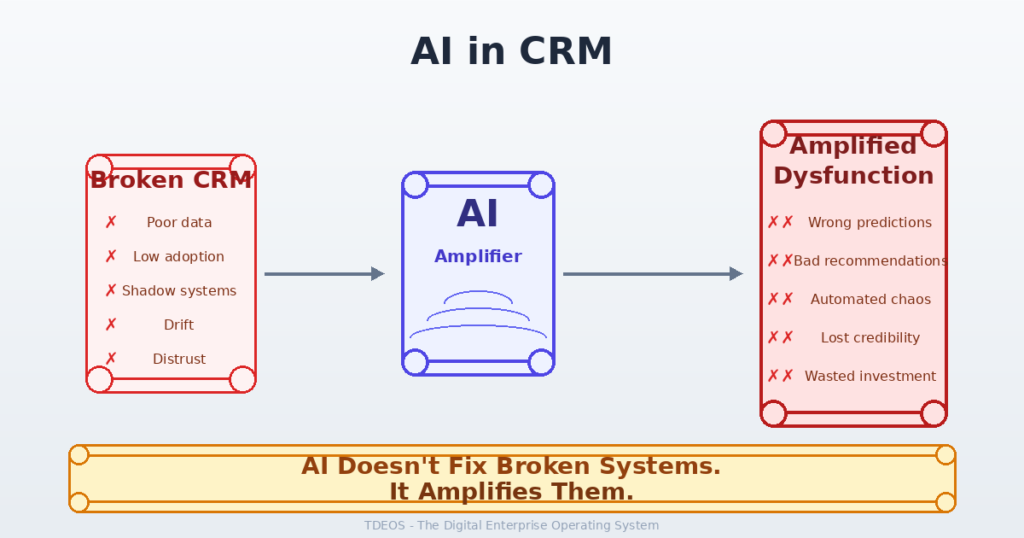
AI in CRM only works when the underlying CRM is trusted and actively used by teams. AI amplifies existing workflows and data quality—if your CRM is drifting, AI outputs become unreliable instead of helpful. Most AI in CRM fails not because the technology is inadequate, but because organizations deploy it on systems that teams have stopped using correctly, data that no longer reflects business reality, and workflows that don’t match how work actually happens. AI doesn’t fix broken systems. It amplifies them.
The Promise of AI in CRM
Executives see AI in CRM as the solution to problems their teams have struggled with for years.
Lead scoring that identifies which prospects are most likely to close. Pipeline forecasting that’s more accurate than sales rep estimates. Churn prediction that catches at-risk customers before they leave. Automated next-best actions that tell reps exactly what to do next. AI copilots that draft emails, summarize conversations, and update records automatically.
The technology is real. The demos are impressive. The ROI projections are compelling.
But most AI in CRM initiatives fail within the first six months. Not because the AI doesn’t work. Because the CRM underneath it is broken.
Why Most AI in CRM Fails
AI learns from your CRM data. It identifies patterns in how deals progress, which behaviors correlate with wins, what signals indicate churn risk, and which actions lead to successful outcomes.
The problem: most mid-market CRMs don’t contain reliable patterns to learn from.
Poor data quality. Contact information is incomplete. Deal stages are outdated. Activities are logged days or weeks after they happen, if at all. Custom fields are filled with placeholder text just to move records forward. The AI trains on garbage data and produces garbage predictions.
Inconsistent workflows. Different reps use different processes. Sales stages mean different things to different people. One rep marks a deal “qualified” after a discovery call. Another marks it “qualified” after budget confirmation. The AI can’t learn a consistent pattern because there isn’t one.
Low adoption. Teams log into the CRM because it’s required, but real work happens in spreadsheets, Notion databases, or email. The CRM shows compliance activity. The shadow systems show actual work. AI trained on the CRM learns patterns of compliance theater, not actual sales behavior.
Shadow CRM systems. Your best performers maintain their own tracking systems because the official CRM doesn’t serve their needs. The AI never sees the data that actually predicts success because it’s not in the system.
CRM drift. Eighteen months ago, the CRM reflected how work happened. But the business evolved. Strategy changed. Team structure shifted. Product positioning adapted. The CRM configuration didn’t. Now the AI is learning from historical patterns that no longer match current reality.
AI doesn’t fix broken systems. It amplifies them.
If your teams don’t trust the CRM today, they won’t trust AI outputs tomorrow. If leadership asks for “the real numbers” instead of pulling CRM reports, adding AI won’t change that. If your best reps ignore CRM recommendations now, they’ll ignore AI recommendations too.
The Hidden Problem: AI Learns from Your Existing Behavior
AI in CRM is pattern recognition, not insight generation.
It looks at historical data and identifies correlations. Deals that closed had these characteristics. Deals that stalled had those characteristics. Customers who churned showed these warning signs. Successful reps followed this sequence of activities.
Then it applies those patterns to current opportunities. This deal looks like deals that closed, so it gets a high score. That customer shows signals similar to ones who churned, so it gets flagged as at-risk.
The AI assumes the historical patterns are valid. It can’t know that your team stopped using the CRM correctly six months ago. It can’t know that your strategy changed but the CRM configuration didn’t. It can’t understand context that’s missing from the data.
Here’s what that looks like in practice:
Your company stopped targeting manufacturing companies nine months ago to focus on healthcare. But your CRM data shows manufacturing deals historically converted at high rates. So the AI continues scoring manufacturing leads as high priority. Your reps ignore those recommendations because they know the strategy changed. The AI’s credibility erodes.
Your best rep has a 40% close rate, but she maintains detailed account plans in Notion because the CRM doesn’t have the fields she needs. The AI only sees her CRM activity—logged calls, email opens, meeting notes—and misses the actual work that drives her success. It recommends other reps follow her CRM behavior, which isn’t what actually makes her effective.
Your customer success team stopped tracking relationship health in the CRM after the VP left and nobody enforced it. The AI trains on twelve months of missing data and predicts that all customers are healthy because no warning signs are being logged. Actual churn happens and the AI never saw it coming.
AI can’t fix what it can’t see. And in drifting CRMs, most of what matters isn’t visible in the data.
Real-World Example
A healthcare services organization implemented Salesforce three years ago. Initial adoption was strong. Training was thorough. The system was configured properly.
Eighteen months later, almost nobody was using it.
Teams tracked their actual work in Excel and Google Sheets. Salesforce existed to satisfy the requirement of having a CRM. Leadership pulled board reports from spreadsheets maintained outside the system. The CRM showed activity, but that activity didn’t reflect reality.
When leadership proposed implementing AI for pipeline forecasting, the conversation started with enthusiasm. The vendor demos looked impressive. The AI could score leads, predict churn, and automate workflows.
But the discovery process revealed the core problem: the CRM didn’t contain trustworthy data to train on.
Account relationship history was incomplete. Engagement activities were logged inconsistently. Strategic priorities had shifted twice since implementation, but the CRM configuration hadn’t changed. The AI would be learning from patterns that no longer reflected how the organization actually worked.
We didn’t implement AI. We simplified the CRM first.
Replaced Salesforce with a platform designed for mid-market operational simplicity. Rebuilt workflows to match how teams actually worked instead of how consultants recommended they should work. Eliminated complexity that required technical expertise the small team didn’t have. Established governance with the COO owning CRM health, not just IT maintaining infrastructure.
Within three months, teams started using the system daily. Leadership trusted the reports enough to present them at board meetings. Operational visibility improved because the CRM finally reflected operational reality.
Now they’re positioned to evaluate AI. Not because the technology got better. Because the foundation underneath it became reliable.
What Healthy AI in CRM Actually Requires
AI works best in organizations where the CRM reflects operational reality. That requires:
Trusted data. Teams believe the information in the CRM is current and accurate. Leadership uses CRM reports for decisions without asking for “the real numbers” from someone’s spreadsheet.
Defined workflows. Sales stages mean the same thing across the team. Activities are logged consistently. The process in the CRM matches the process teams actually follow.
Active system usage. Reps update the CRM during customer conversations, not afterward from memory or personal notes. Customer success checks the CRM for account health, not Notion databases or Excel trackers.
Clear governance. Someone at the executive level owns whether the CRM serves business decisions. Not just whether it’s maintained, but whether it remains aligned with how work actually happens and business strategy actually evolves.
Simplicity. The CRM contains what teams need to do their jobs, not everything a consultant thought they might need someday. Complexity that accumulated over time has been removed.
Organizational alignment. When strategy changes, the CRM changes with it. When teams identify workflow problems, there’s a process to address them. The system evolves as the business evolves.
AI can amplify effectiveness in organizations with these conditions. It can predict which leads are worth pursuing because the data shows reliable patterns of what actually closes. It can identify at-risk customers because relationship health is tracked consistently. It can recommend next actions because successful behaviors are visible in the system.
But if these conditions don’t exist, AI amplifies dysfunction instead. It makes confident predictions based on unreliable patterns. It recommends actions that worked in historical data but don’t match current strategy. It automates workflows that teams have already abandoned for better approaches in shadow systems.
The question isn’t whether AI in CRM works. The question is whether your CRM is healthy enough that AI has something reliable to work with.
Why Mid-Market Companies Struggle More
Enterprise companies have resources that mid-market companies don’t.
They have RevOps teams dedicated to maintaining CRM health, data quality, and process alignment. They have governance frameworks that catch drift early. They have change management resources to keep adoption high when systems evolve. They have the budget to hire consultants who configure AI properly and tune it over time.
Mid-market companies—50 to 500 employees, $10M to $100M in revenue—typically have none of these.
Your operations person manages the CRM in addition to three other responsibilities. You don’t have a dedicated RevOps function. Change management happens through department heads who are already stretched. When the CRM vendor sells you AI features, there’s nobody with the time or expertise to verify whether your data quality supports it.
This creates a trap.
Enterprise AI tooling assumes enterprise resources. It assumes you can dedicate someone to monitoring AI performance. It assumes you have data analysts who can tune scoring models. It assumes you have governance structures that prevent the underlying CRM from drifting while the AI runs on top of it.
When those assumptions don’t hold, AI in CRM creates more problems than it solves. The AI makes recommendations nobody trusts. It automates workflows that don’t match reality. It adds complexity to a system teams were already struggling to use effectively.
The platforms aren’t designed for organizations that can’t afford enterprise support. But they’re sold to those organizations anyway.
This is why simplicity matters more for mid-market companies than sophisticated features. A simpler CRM that teams actually use provides more value than a complex platform with AI features that run on unreliable data.
AI in CRM isn’t a mid-market solution. It’s an enterprise solution that requires enterprise resources to deploy successfully. For mid-market companies, the path to AI starts with operational fundamentals: trusted data, defined processes, consistent usage, and governance structures that maintain all three over time.
How to Prepare Your CRM for AI
If you’re considering AI in CRM, prepare the foundation before deploying the technology.
Simplify the CRM. Audit what’s actually being used. Remove unused fields, delete obsolete workflows, archive reports nobody opens. Every piece of complexity that isn’t actively serving daily work is creating data quality problems and making AI training less effective.
Clean the data. Define what “complete” means for critical records. Deduplicate contacts and accounts. Standardize naming conventions. Fill gaps in historical data or mark it clearly as incomplete so AI doesn’t train on it. Budget 40 to 60 hours for a mid-market CRM.
Align workflows with reality. Shadow your teams. Watch how work actually happens. Redesign CRM workflows to match observed reality instead of idealized processes. If teams are maintaining shadow systems, that’s a signal the official workflows don’t serve real needs.
Rebuild trust. Leadership needs to trust CRM data enough to use it for decisions without asking for “the real numbers” elsewhere. Start with one report that’s consistently accurate. Deliver it weekly. Prove the system can be relied on for this one thing. Then expand.
Establish governance. Assign executive ownership of CRM health. Not IT maintaining infrastructure. Someone at the COO or VP Operations level who owns whether the system serves business decisions and remains aligned with how work actually happens.
Measure leading indicators. Don’t wait for AI performance to tell you the CRM is unhealthy. Track adoption metrics, data completeness rates, and usage patterns. If teams stop logging activities consistently or start maintaining shadow trackers, that’s drift starting. Catch it early.
This work takes eight to sixteen weeks depending on how advanced the drift is. It’s not optional preparation for AI. It’s the foundation that determines whether AI amplifies success or chaos.
Many organizations skip this work because AI vendors promise their tools will work regardless of data quality. Some will claim their AI “cleans the data automatically” or “works with messy data.”
That’s marketing language obscuring operational reality. AI can’t create patterns that don’t exist in the data. It can’t understand context that was never captured. It can’t distinguish between reliable historical patterns and artifacts of a drifting CRM.
Fix the foundation first. Then deploy AI from a position of operational strength.
The Real Question About AI in CRM
The question isn’t whether AI in CRM works. The technology is sophisticated and continuously improving.
The question is whether your organization is ready for it.
If your teams don’t use the CRM consistently, AI won’t change that. If your data quality is poor, AI will learn from poor data. If leadership doesn’t trust CRM reports today, they won’t trust AI-generated insights tomorrow.
AI amplifies what already exists. If your CRM reflects operational reality—teams use it daily, data is trusted, workflows match how work happens—AI can amplify that effectiveness. Predictions become more accurate. Recommendations become more relevant. Automation saves genuine time.
But if your CRM is drifting—teams maintain shadow systems, data is incomplete, workflows don’t match reality—AI amplifies that dysfunction. Predictions are confidently wrong. Recommendations are ignored. Automation creates more work than it saves.
Most AI in CRM fails not in the deployment phase. It fails in the months or years before deployment when the CRM drifted away from operational reality and nobody addressed it.
The path to successful AI in CRM doesn’t start with evaluating AI vendors. It starts with honest assessment of whether your CRM is healthy enough that AI has something reliable to amplify.
If Your CRM Data Isn’t Trusted, AI Won’t Solve the Problem
AI doesn’t fix broken systems. It amplifies them.
If your teams are tracking real work in spreadsheets instead of the CRM, adding AI won’t change that behavior. If leadership asks for “the real numbers” instead of pulling CRM reports, AI-generated forecasts won’t be trusted either. If your best performers ignore the CRM, they’ll ignore AI recommendations.
Before investing in AI for CRM, invest in CRM health.
Simplify the system. Clean the data. Align workflows with reality. Rebuild trust through consistent, accurate reporting. Establish governance that prevents drift from returning.
Then evaluate AI from a position where the underlying data, processes, and adoption can support it.
Start with a CRM Assessment to understand whether your CRM is ready for AI—or whether you need to fix the foundation first.
Learn more: https://tdeos.com/crm
Or discuss your specific situation: https://tdeos.com/#get-in-touch
Frequently Asked Questions About CRM Drift
Q: Can AI clean up our CRM data automatically?
A: No. AI can identify some data quality issues like duplicates or missing fields, but it cannot determine what the correct data should be or understand which historical patterns are valid versus artifacts of drift. Data cleanup requires human judgment about what information is current, accurate, and relevant to business strategy. AI vendors who promise automatic data cleaning are selling a capability that doesn’t exist at the scale needed to fix a drifting CRM.
Q: We have low CRM adoption. Will AI features make teams use it more?
A: No. Teams don’t use the CRM because it doesn’t serve their daily work needs, is too complex for the value it provides, or they don’t trust the data it contains. Adding AI features increases complexity without addressing the underlying adoption problems. If teams are maintaining shadow systems in Excel or Notion, AI in the official CRM won’t change that behavior. Fix adoption first by simplifying the system and aligning it with how work actually happens.
Q: Our CRM vendor says their AI works even with messy data. Is that true?
A: Partially. AI can function with incomplete data, but the quality of outputs degrades proportionally to data quality. An AI trained on 60% complete records will produce less reliable predictions than one trained on 95% complete records. AI trained on data from a period when strategy was different will recommend actions that no longer align with current business direction. “Works with messy data” means “will produce output,” not “will produce reliable output.”
Q: How do we know if our CRM is ready for AI?
A: Ask these questions: Do teams actually use the CRM for daily work, or maintain separate trackers? Does leadership trust CRM reports for board presentations, or ask for “real numbers” from spreadsheets? Are workflows in the CRM aligned with how work actually happens today? Has strategy changed since the CRM was configured? If teams use the system, leadership trusts the data, and workflows match reality, you’re ready. If not, you’re not.
Q: What’s the biggest mistake companies make with AI in CRM?
A: Deploying AI without assessing whether the underlying CRM is healthy. They assume AI will improve a struggling system instead of recognizing that AI amplifies whatever already exists. If the CRM is drifting—low adoption, poor data, misaligned workflows—AI makes those problems more visible and more costly. The biggest mistake is treating AI as a solution to CRM problems instead of a capability that requires CRM health as a prerequisite.
Q: Can mid-market companies successfully use AI in CRM?
A: Yes, but only if they have operational fundamentals in place: trusted data, defined workflows, consistent usage, and governance. Most enterprise AI tooling assumes resources mid-market companies don’t have—RevOps teams, data analysts, dedicated admins. Mid-market success with AI in CRM requires simpler platforms designed for organizations without enterprise support structures, and deliberate investment in CRM health before AI deployment.
Q: How long does it take to prepare a CRM for AI?
A: Eight to sixteen weeks for most mid-market organizations with moderate drift. This includes simplifying complexity, cleaning data, realigning workflows, and rebuilding trust through consistent accurate reporting. Organizations with advanced drift (18+ months since implementation, extensive shadow systems, complete loss of leadership trust) may need twelve to twenty weeks. The timeline depends on how far the CRM has drifted from operational reality.
are struggling with CRM adoption, data quality, or considering AI initiatives.
About TDEOS
TDEOS helps mid-market companies fix broken CRM systems and eliminate shadow CRM proliferation.
We work with organizations (50-500 employees) in healthcare, nonprofits, financial services, and professional services that are struggling with CRM adoption, data quality, or considering AI initiatives.
Common situations we address:
- Low CRM adoption, teams using spreadsheets instead
- Poor data quality undermining AI initiatives
- Leadership doesn’t trust CRM reports
- Evaluating whether to AI to existing CRM
- CRM drift after initial implementation success
Founder: Raman Arora
Background: 22+ years Fortune 500 operations at GE Aviation, Dell, and Paycor leading CRM implementations, revenue operations, and digital transformation initiatives.
Approach: Fix CRM Health and operational alignment before deploying AI. Assess readiness honestly. Deploy AI from operational strenght not hope.
Location: Cincinnati, Ohio (serving nationwide)
Contact: https://tdeos.com/contact-us
LinkedIn: https://www.linkedin.com/in/ra-arora
Clutch Verified Reviews: https://clutch.co/profile/tdeos
Related Resources
Articles on CRM Problems:
CRM Drift: Why CRM Systems Fail After Implementation
https://tdeos.com/crm/crm-drift/
Shadow CRM Systems: When Teams Build Their Own Tracking Tools
https://tdeos.com/crm/shadow-crm/
Why Leadership Stops Trusting the CRM
https://tdeos.com/when-leadership-stops-trusting-the-crm/
The Year After Go-Live: Why CRM Success Turns Into Struggle
https://tdeos.com/the-year-after-go-live-why-crm-success-turns-into-crm-struggle/
Four Platforms Made the Same AI Bet: Why Mid-Market Should Wait
https://tdeos.com/insights/ai-agents-mid-market-four-platforms/