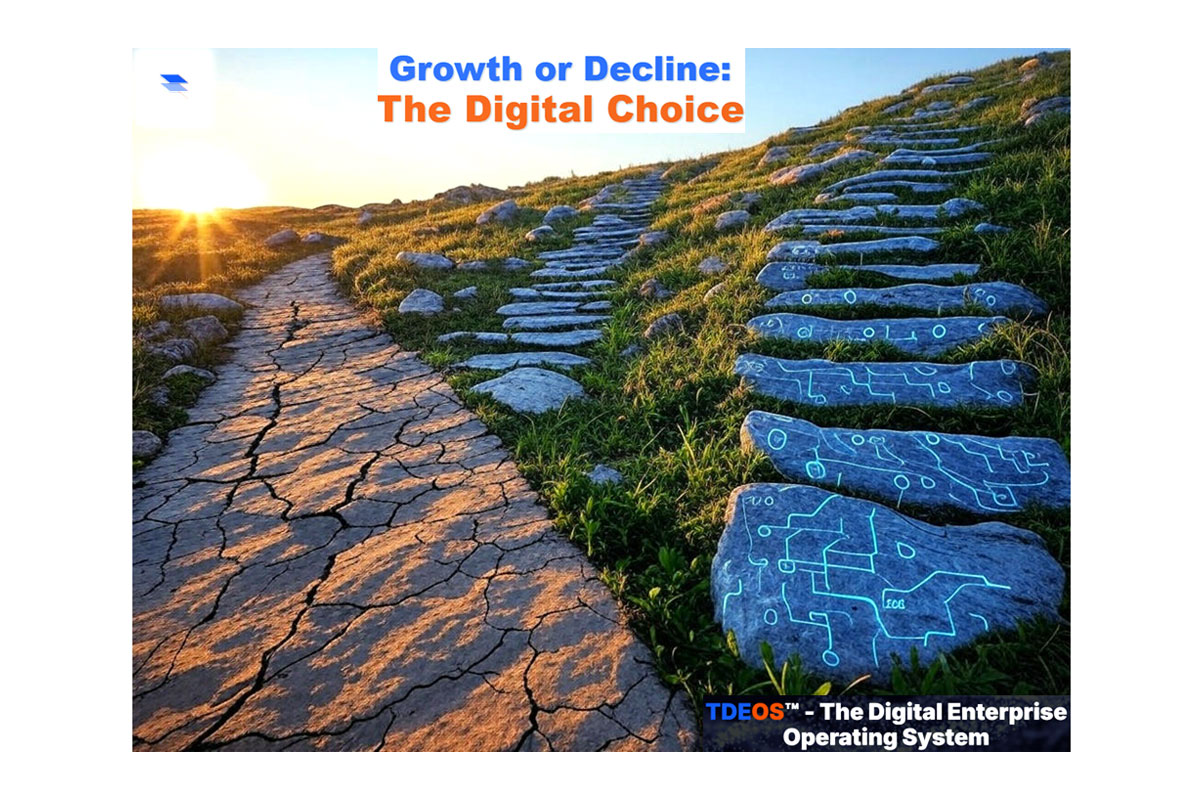
In today’s hyper-competitive market, businesses face a stark reality: grow or decline . There is no steady-state where companies can afford to maintain the status quo indefinitely. From my experience working with enterprises across industries, I’ve observed a clear pattern—organizatiobs that fail to sustain growth inevitably begin to deteriorate —slowly at first, then rapidly as market dynamics accelerate.
The Growth Challenge
CEOs and boards struggling with growth often find themselves confronting a common obstacle: digital disruption.
Competitors leveraging advanced technologies and AI capabilities are capturing market share, leaving traditional players fighting to maintain relevance. The pie isn’t getting bigger—it’s being redistributed to those who embrace digital transformation effectively.
What business leaders cannot afford to do is let their organizations shrink. They must continually invest in growth strategies, and increasingly, these strategies must be technology-enabled.
The Technology Growth Equation
Technology can drive business growth in three primary ways:
- Enhancing existing products and services: Implementing predictive maintenance in manufacturing operations, using AI to improve customer service response times, or leveraging data analytics for more effective inventory management.
- Creating new digital business lines: Developing technology-enabled products or services that open entirely new revenue streams or market segments.
- Commercializing internal solutions: Identifying successful internal technology implementations that can be packaged and sold to others facing similar challenges.
The Leadership Disconnect
The challenge? Many C-suite leaders and board members lack the technological fluency to execute these strategies confidently. This leadership gap creates significant business risks:
- Avoidance of critical technology investments due to discomfort with complex concepts like AI, data science, or predictive analytics
- Self-imposed limitations on growth due to lack of digital expertise
- Misguided investments in the wrong technology initiatives
- Failed implementation of potentially valuable digital capabilities
These risks aren’t theoretical. The technology project failure rate remains stubbornly high, with research suggesting up to 70% of digital transformation initiatives fail to achieve their objectives.
One key factor: technology ownership by leaders who don’t fully understand how digital capabilities translate to business value.
The Growth Imperative
Businesses unable to grow eventually face existential threats. This decline rarely happens overnight—it’s a gradual erosion of competitiveness, customer relevance, and market position until the organization reaches a tipping point.
However, this fate isn’t inevitable. Organizations can thrive when leadership:
- Focuses intensely on how digital technology creates value for customers
- Develops strategies that directly connect technology capabilities to business outcomes
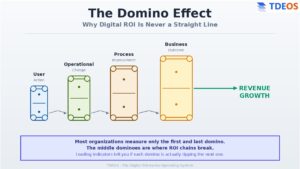
- Implements robust measurement systems that track the business impact of digital investments
The TDEOS Approach
At TDEOS (The Digital Enterprise Operating System), we’ve developed a proven methodology that helps businesses expand their digital footprint, incorporate technology into their core offerings, and drive sustainable growth.
Our framework bridges the gap between technical complexity and business value, enabling leaders to make confident technology decisions without requiring deep technical expertise. By integrating strategic vision with execution excellence and value realization, TDEOS creates a sustainable system for technology-enabled growth.
As markets continue to evolve at an accelerating pace, the choice becomes increasingly clear: embrace digital transformation as a growth engine or risk gradual decline.
The businesses that thrive will be those where leadership recognizes that technology isn’t just an operational tool—it’s the foundation of their future growth strategy.
What challenges is your organization facing in leveraging technology for growth? I’d be interested in hearing your perspective.