Introduction
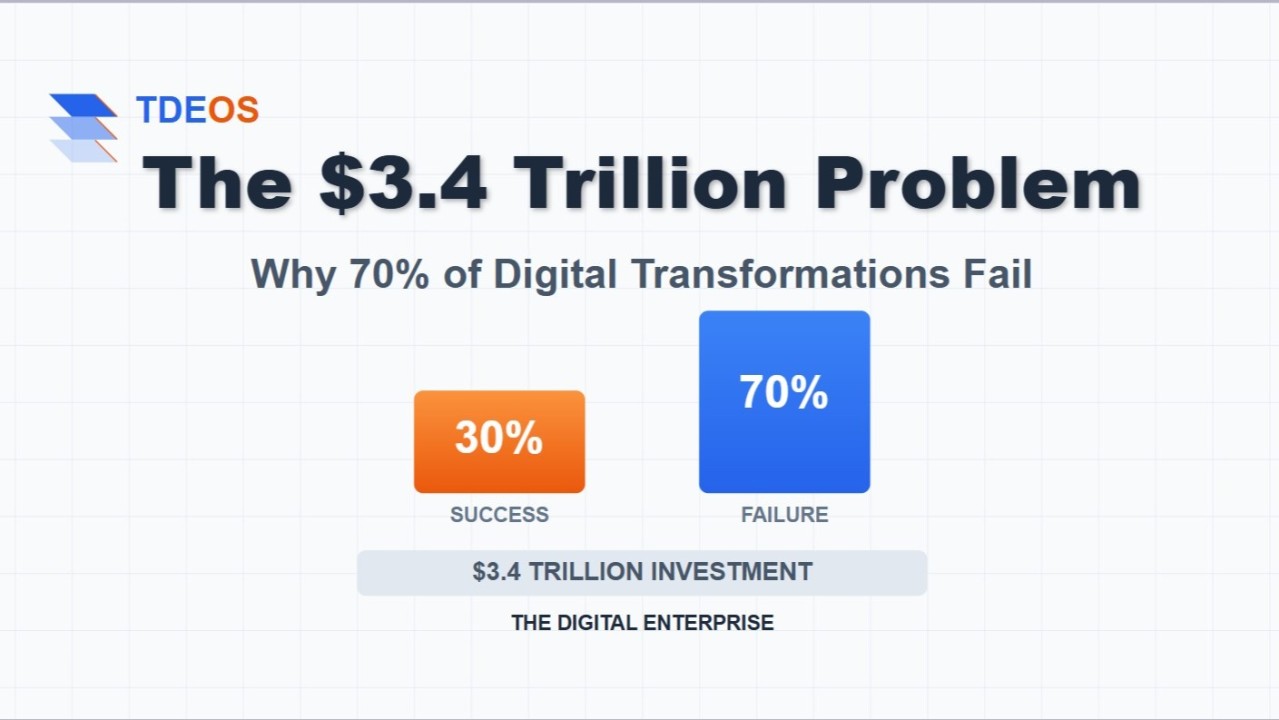
In 2023, companies invested $1.6 trillion in digital and AI-powered transformation. By 2026, that figure will double to $3.4 trillion.
Yet, despite massive investments, McKinsey, BCG, and Gartner consistently report that 70% of these initiatives fail to achieve expected business outcomes.
The result?
- Wasted capital
- Missed revenue opportunities
- Competitive disadvantage
What’s going wrong? Most digital transformations focus on technology rather than value.
This leads to the Digital Value Gap—a disconnect between technology implementation and real business impact.
Why Digital Transformations Fail
The most common failure patterns boil down to four critical mistakes:
1️⃣ Strategy-Execution Disconnect
- Leadership envisions AI-powered customer experiences, automation, and data-driven decision-making.
- But execution teams lack a clear path to turn vision into reality.
Case Example: A bank invested $50M in a digital customer experience platform—but customer satisfaction scores remained flat. Why?
- The IT team optimized features, but the customer journey wasn’t redesigned.
- No alignment between business goals and technology execution.
2️⃣ The Technology-First Trap
- Companies rush into cloud, AI, and automation without solving a specific business problem.
- Digital investments become a checklist rather than a strategic advantage.
Case Example: A manufacturing giant rolled out AI-driven predictive maintenance across 200 facilities.
- The system worked technically, but maintenance teams ignored AI recommendations and continued using old workflows.
- Result? The company achieved only 15% of the expected cost savings.
3️⃣ The Change Management Deficit
- Organizations underestimate resistance to new ways of working.
- Employees see digital changes as “another IT project” rather than a shift in how they work.
- Training happens too late, adoption is low, and digital fatigue sets in.
Case Example: A healthcare provider introduced AI-powered clinical decision support tools.
- Problem? Only 20% of physicians adopted them—most continued relying on manual processes.
- Why? No change management strategy, no incentives, and no cultural shift.
4️⃣ Measurement Misalignment
- Companies measure system uptime, software adoption, and project completion—not business impact.
- The focus remains on launching tech rather than tracking revenue growth, cost efficiency, or customer satisfaction.
📊 The Fix? Shift from Technical Metrics → Business Metrics.
- Instead of tracking “% of AI models deployed”, measure “% revenue growth from AI-driven insights.”
- Instead of “ERP go-live date”, track “cost reduction & efficiency gains.”
💰 The True Cost of Digital Failure
- Financial Loss: Millions spent on digital projects that don’t improve revenue, efficiency, or customer retention.
- Eroded Trust: Employees, executives, and investors lose faith in digital initiatives.
- Competitive Disadvantage: Agile competitors gain an edge, while laggards struggle to keep up.
Research shows:
- Digital laggards lose 2-3% market share per year compared to digital leaders.
- AI-driven companies see 26% higher profitability than competitors who struggle with digital execution.
🚀 How to Close the Digital Value Gap?
At TDEOS – The Digital Enterprise Operating System, we take a value-first approach to digital transformation.
- Enterprise Evolution Over Tech Deployment – Technology should serve the business, not drive it.
- Strategic Alignment & Execution Discipline – Connecting business goals to execution pathways.
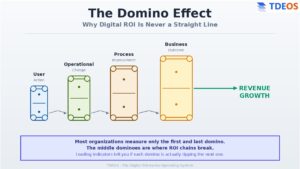
- Continuous Value Measurement – Tracking leading indicators to ensure real ROI.
🔹 Companies using TDEOS principles typically see:
- 2-3X ROI on digital investments
- 40-60% faster realization of business impact
- 30-50% higher adoption & engagement
💡 The future of digital transformation isn’t about technology—it’s about impact.
If you’re leading a transformation effort, let’s connect! What’s the biggest challenge you’ve faced? Drop your thoughts below. 👇