The $3.4 Trillion Question
After exploring the sobering reality of digital transformation failures in my previous newsletters, it’s time to shift from problems to solutions.
The question remains:
How do organizations bridge the Digital Value Gap to ensure technology investments consistently deliver meaningful business impact?
This challenge led to the development of The Digital Enterprise Operating System (TDEOS)—a comprehensive framework I’ve refined over two decades of leading digital transformations across industries.
Unlike traditional approaches, TDEOS isn’t theoretical—it’s battle-tested through successes and failures alike, emerging from real-world experience with Fortune 500 digital initiatives.
The Transformation Paradigm Shift
Traditional digital transformation models are outdated—they can’t keep pace with the speed of technological change.
The TDEOS framework addresses this with five critical paradigm shifts that close the Digital Value Gap:
1. From Initiatives to Digital Product Management
Traditional transformation is treated as a series of projects with defined end dates. TDEOS reimagines transformation as continuous digital product management, focusing on value realization, not project completion.
2. From Siloed Delivery to Domain-Based Value Creation
Many organizations adopt modern methodologies but still operate in silos—IT, business, and operations remain disconnected. TDEOS organizes transformation around domains, ensuring end-to-end accountability for business outcomes.
3. From IT Delivery to Business Evolution
Old models treat IT as an order-taker executing business requirements. TDEOS creates a co-ownership model, where IT and business leaders drive transformation together.
4. From Technical Metrics to Value Realization
Measuring uptime, adoption, and feature releases isn’t enough. TDEOS establishes a direct connection between technology and business KPIs—revenue, cost optimization, customer experience, and efficiency.
5. From Implementation to Transformation
Most organizations declare success when systems go live. TDEOS recognizes that real transformation begins post-implementation—when technology enables new business capabilities.
🚀 Bottom Line: The TDEOS framework ensures digital transformation delivers real business value—not just technology deployments.
The Three Pillars of TDEOS
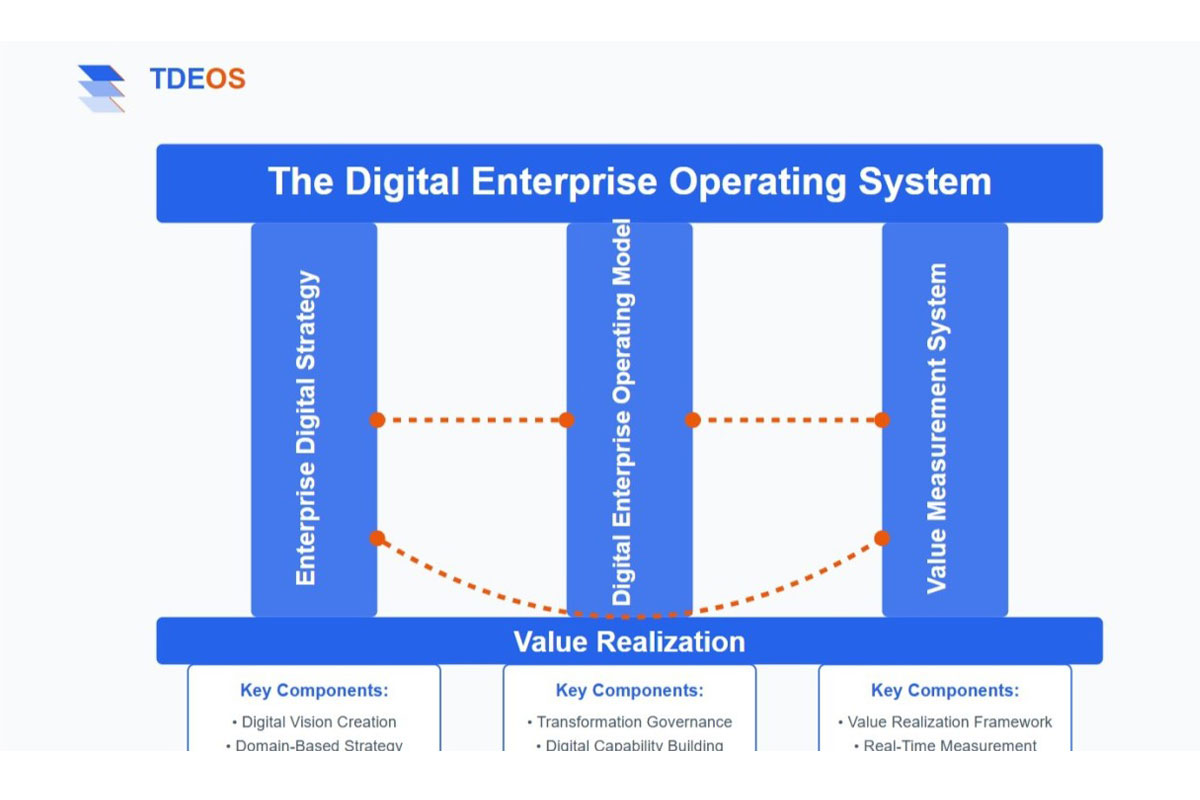
What makes TDEOS fundamentally different? It connects strategy, execution, and value measurement into an integrated system.
Unlike traditional methods that create silos between strategy, execution, and measurement, TDEOS connects these elements into a cohesive system through three integrated pillars
🟢 Pillar 1: Enterprise Digital Strategy
The foundation of value realization is a digital strategy that directly connects business objectives to technological enablement. This pillar ensures that every digital initiative begins with clear business outcomes and maintains this focus throughout execution.
🔹 Aligns business strategy with technology enablement
🔹 Prioritizes value-driven digital opportunities
🔹 Defines business-case-driven investment planning
🟢 Pillar 2: Digital Enterprise Operating Model
Successful transformation requires more than strategy—it demands a cohesive operating model that enables execution. This pillar ensures that the organization can effectively execute on strategic intent and sustain new capabilities over time.
🔹 Establishes governance & execution structures
🔹 Builds digital capabilities & domain-based implementation
🔹 Embeds change enablement throughout transformation
🟢 Pillar 3: Value Measurement System
What gets measured gets managed—and what gets managed gets improved. This pillar ensures that value realization remains the central focus throughout the transformation journey and beyond.
🔹 Implements a real-time value realization framework
🔹 Tracks leading & lagging indicators for continuous improvement
🔹 Ensures long-term sustainability of digital impact
🔍 Result? TDEOS eliminates wasteful technology spending and ensures every dollar invested drives business growth.
Traditional Approach vs. TDEOS Approach
TDEOS isn’t just a better way to execute transformation—it redefines how organizations drive business value.
📊 Key Outcomes for Companies Implementing TDEOS:
✅ 2-3x higher return on digital investments
✅ 40-60% faster time-to-value realization
✅ 30-50% higher adoption and stakeholder satisfaction
TDEOS is built for companies that want transformation to be a long-term success—not just another IT project.
Addressing the Key Failure Modes
The TDEOS framework systematically eliminates the most common reasons why digital transformations fail:
🚫 Strategy-Execution Disconnect → TDEOS ensures strategy drives execution, not the other way around.
🚫 Technology-First Trap → TDEOS aligns digital solutions with real business problems.
🚫 Weak Change Management → TDEOS embeds change enablement from Day 1.
🚫 Poor Value Measurement → TDEOS tracks business outcomes, not just IT performance.
💡 TDEOS doesn’t just fix digital transformation—it makes it a competitive advantage.
The Value Realization Timeline
Unlike traditional models, TDEOS doesn’t wait for “project completion” to measure value.
🔹 First 90 Days: Quick wins & early adoption (5-10% of total value)
🔹 Months 3-6: Core capabilities & process transformation (15-25% of value)
🔹 Months 6-12: Scaling implementation & driving adoption (40-60% of value)
🔹 Year 2+: Continuous optimization & long-term impact (100%+ of initial value)
🔍 This phased approach ensures early wins while building momentum for sustained success.
Moving Forward
In the coming weeks, I’ll deep dive into each pillar of the TDEOS framework and explore:
✅ How companies can leverage digital transformation—even without massive IT teams. ✅ Why Fractional CIOs are the secret weapon for companies struggling with IT strategy. ✅ The step-by-step playbook for turning digital initiatives into real business value.
🚀 Next up: Fractional CIOs—Why You Don’t Need a Full-Time IT Leader to Win in the Digital Age.
What Do You Think?
📩 Which of these five paradigm shifts resonates most with you? Leave your comment —I’d love to hear your thoughts.
📌 If you found this insightful, share it with a colleague who’s navigating digital transformation!
📌 Follow for weekly insights on building a high-impact Digital Enterprise by subscribing to the newsletter🔗 “The Digital Enterprise“